2026-08-26
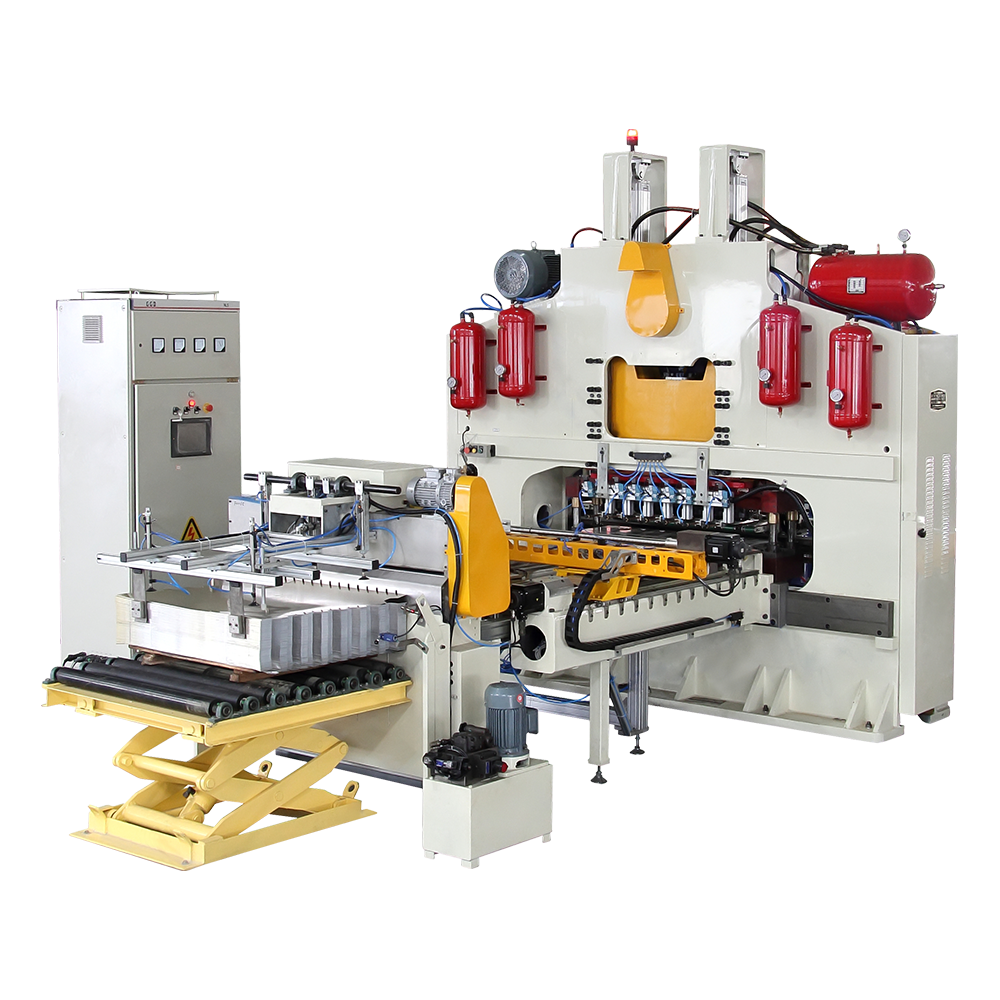
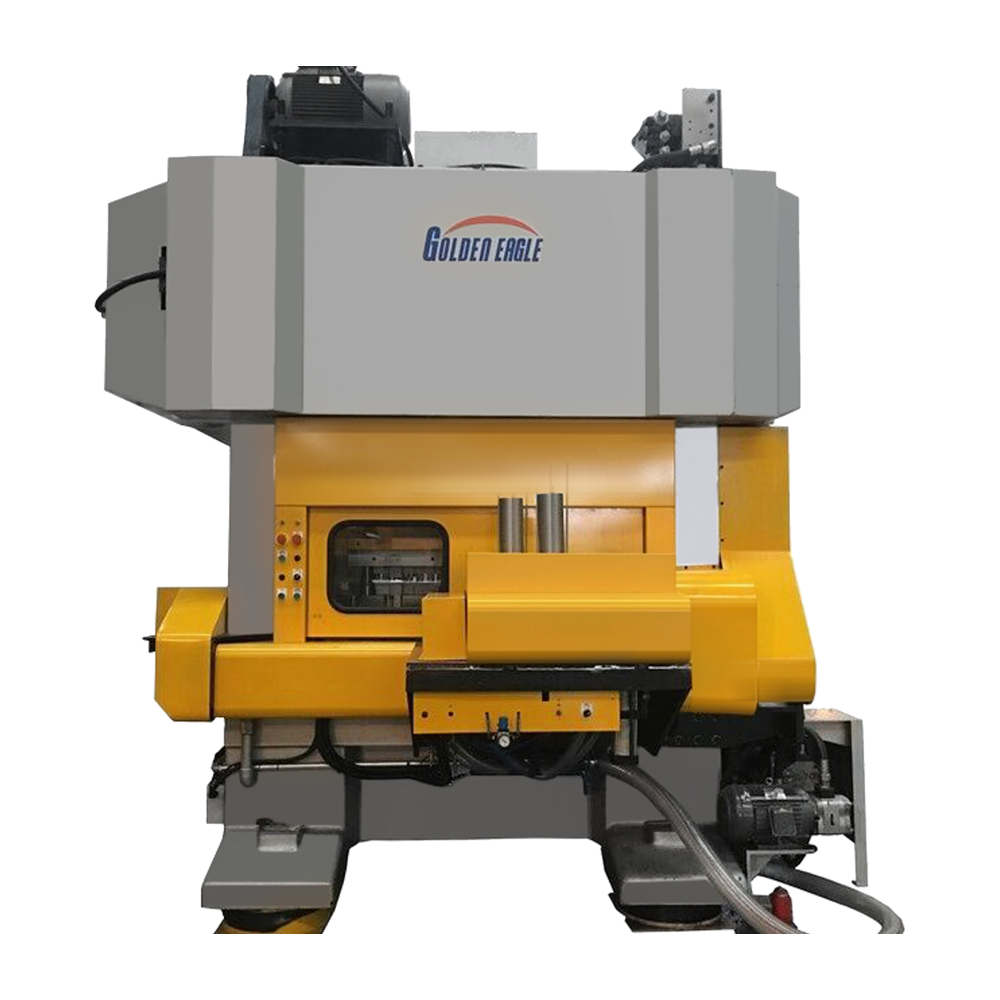
In modern metal packaging production, the conversion press is one of the most important machines in the can end manufacturing process. It transforms accurately prepared metal shells into finished can ends through a carefully controlled sequence of operations, including forming, curling, beading, scoring, riveting, and other functions required by the final product design. The quality, stability, and productivity of the die installed in the conversion press directly influence the performance of the complete production line.
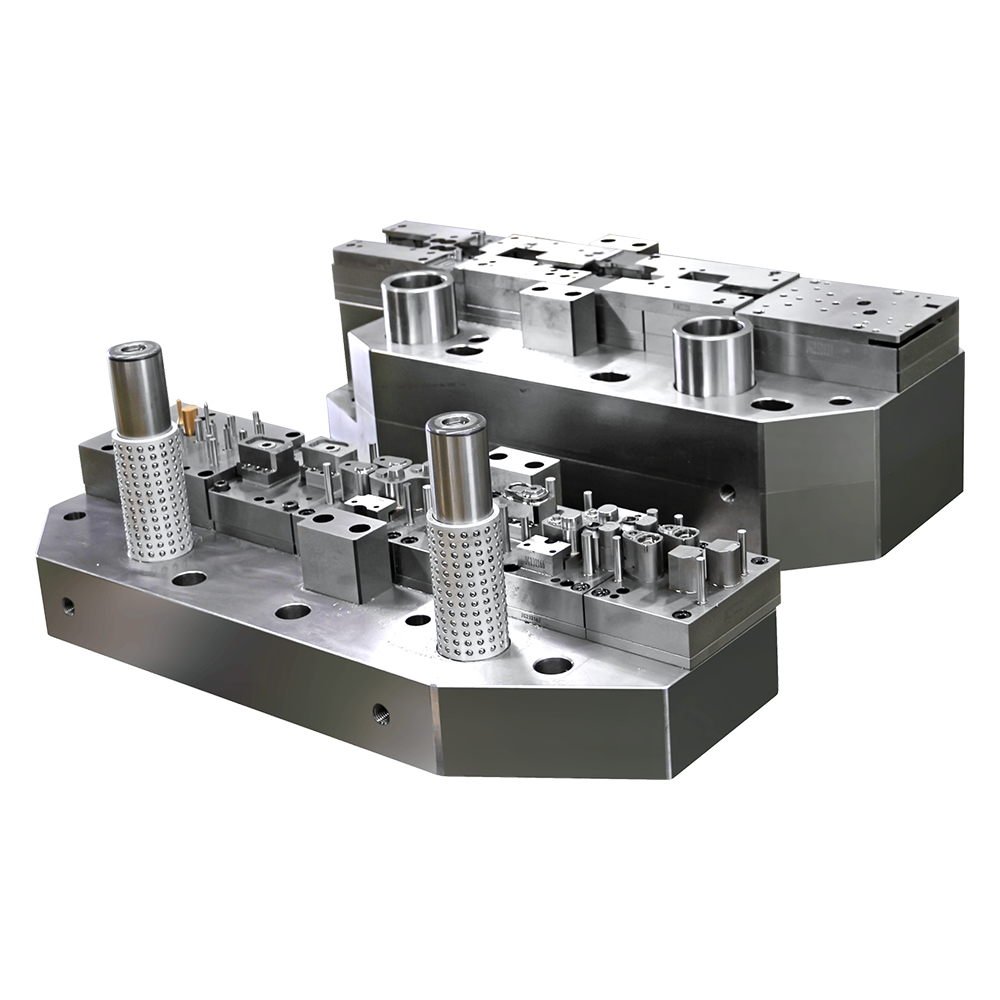
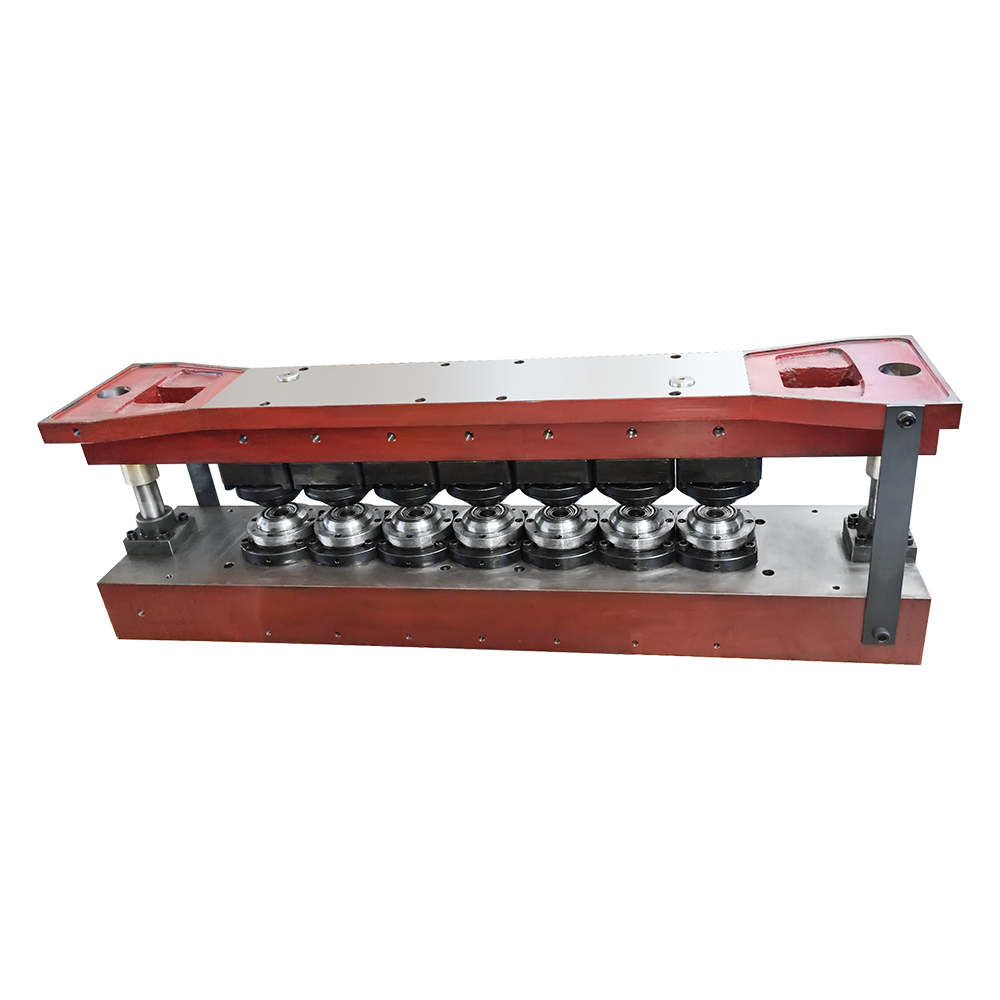
A conversion press double row die is designed to support efficient two-row production. By arranging forming stations in a double-row configuration, the die can increase output while maintaining controlled material movement and consistent forming quality. It is suitable for manufacturers producing tinplate or other compatible metal can ends for food, beverage, chemical, aerosol, and general industrial packaging applications. When correctly designed and manufactured, the double row die can help improve production capacity, reduce unit processing costs, and support reliable long-term operation.
This article explains the working principles, construction, manufacturing process, operational advantages, maintenance requirements, selection considerations, and application value of a conversion press double row die. It also examines how advanced machining equipment, experienced engineering personnel, quality management, and practical production knowledge contribute to die performance.
A conversion press die is a precision tooling system installed inside a press. Its primary purpose is to convert a previously formed metal shell or blank into a can end with the required geometric features. The die controls the position, shape, and movement of the workpiece during pressing. It also determines how individual operations are distributed across the press stations.
The phrase “double row” refers to the arrangement of two parallel production paths within the tooling system. Depending on the press design and the product specification, two workpieces may be processed simultaneously at each operating cycle. This arrangement makes better use of press capacity and can significantly increase the number of completed can ends produced during a given period.
A double row die is not simply a larger single-row die. It requires careful coordination between the two rows, including balanced force distribution, synchronized feeding, accurate guide movement, and consistent clearance. If the two rows do not operate evenly, the result may be uneven forming, dimensional variation, excessive wear, or frequent production interruptions. For this reason, the design and manufacture of double row tooling require considerable experience in can-making machinery and metal forming technology.
The die may be configured for different can end types and production requirements. The actual design depends on factors such as metal thickness, material grade, end diameter, shell geometry, score pattern, tab or rivet structure, required output, press stroke, and the sequence of operations. A professional tooling manufacturer normally evaluates these parameters before confirming the final die structure.
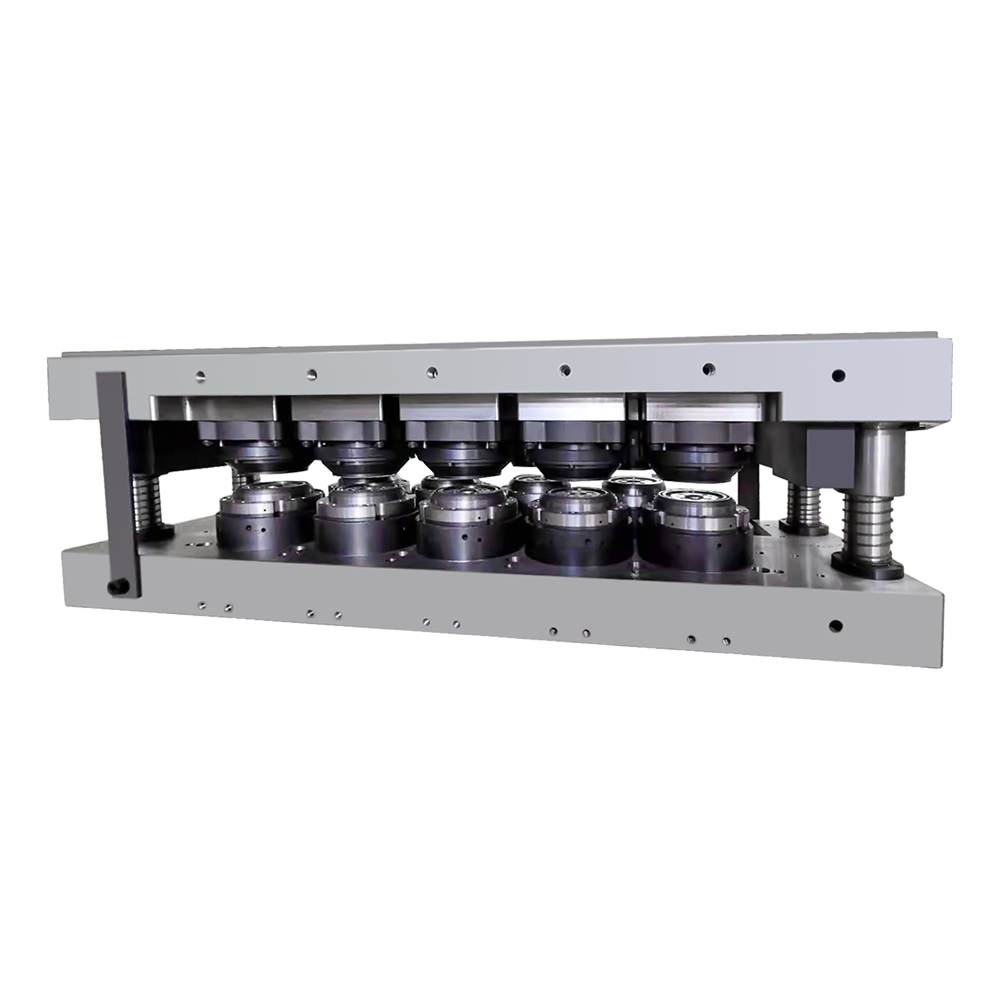
Conversion Press Double Row Die
Can ends must meet strict requirements. They need to fit accurately with the can body, maintain a reliable seal, resist deformation during filling and transportation, and provide suitable opening or closing performance when applicable. For food and beverage containers, the end must also support product safety and hygienic packaging conditions. For chemical or aerosol containers, the end may need to withstand higher internal pressure or more demanding environmental conditions.
The conversion press die contributes to these requirements by controlling the metal throughout the forming process. It ensures that the shell is held in the correct position and that the forming tools apply force in a repeatable manner. The die also helps maintain the relationship between the end panel, countersink, chuck wall, curl, score line, and other structural areas.
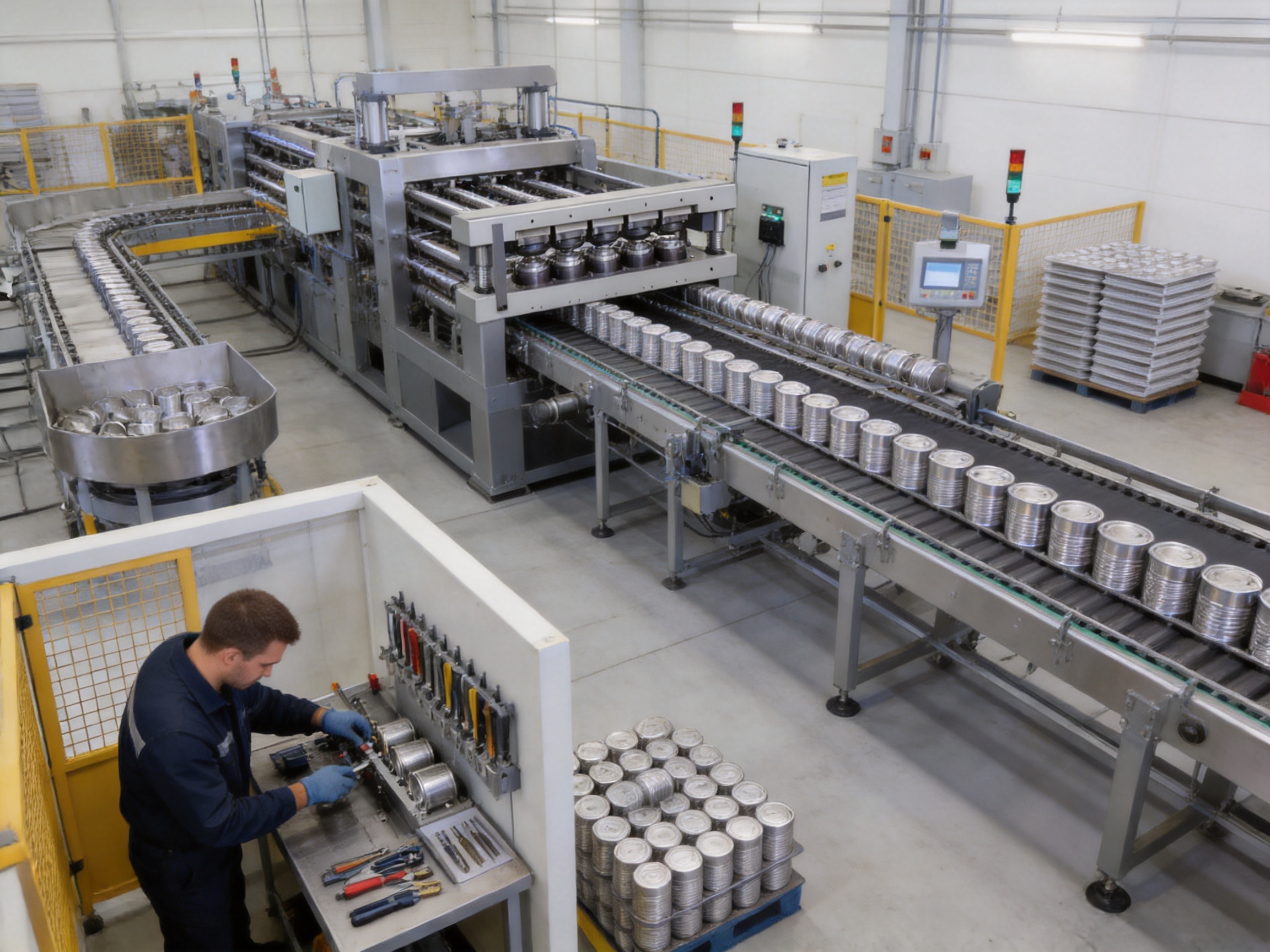
In many production lines, the die works after earlier processes such as blanking, shell pressing, compound forming, or shell feeding. It may be integrated with an automatic feeding machine and connected to subsequent inspection, sealing compound application, stacking, or packing equipment. The tooling therefore needs to operate as part of a complete line rather than as an isolated component.
Stable tooling performance is especially important in high-speed production. A small dimensional error may be repeated thousands of times during a production shift. If the die creates inconsistent parts, the problem can affect downstream equipment, increase rejection rates, interrupt the line, and raise material consumption. A properly engineered double row die reduces these risks by combining precision manufacturing with controlled operating conditions.
The most visible feature of this type of tooling is the parallel arrangement of two forming rows. The layout is developed to fit the available press space and to synchronize both production paths. The two rows must maintain equal pitch, consistent alignment, and balanced resistance during the press cycle.
A well-designed layout can improve productivity without requiring a proportional increase in floor space. It may also allow the manufacturer to use the existing press more efficiently. However, the actual output improvement depends on press speed, material handling, product size, operator skill, feeding stability, and the complexity of the can end design.
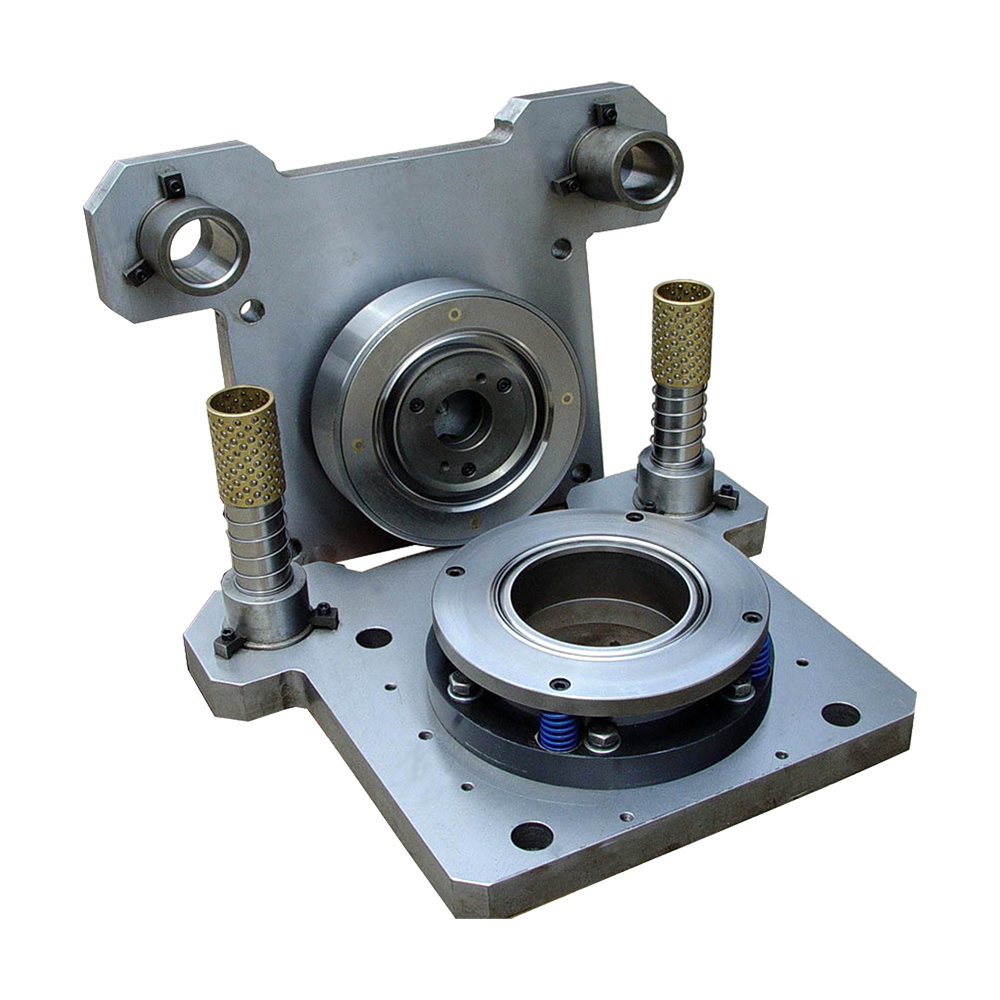
Guide posts, guide bushes, locating components, and other alignment elements help maintain the relative position of the upper and lower die assemblies. Precision guidance is essential because even a small misalignment can affect the clearance between forming surfaces.
Accurate guidance supports uniform forming and helps protect the working parts from abnormal impact. It can also reduce vibration and prevent premature wear. During maintenance, guide components should be inspected for scoring, looseness, contamination, and changes in running clearance.
Depending on the product configuration, the die may include components for forming the end panel, creating a countersink, producing a curl, forming a bead, cutting or scoring the opening feature, and completing other required operations. Each component must be matched to the material and the desired final dimensions.
Cutting edges and scoring tools require particularly careful treatment. They must be sharp and correctly aligned, but they must not be so fragile that normal production causes rapid chipping or breakage. The surface finish and hardness of working components also influence service life and product quality.
The workpiece must move smoothly through the tooling without twisting, scratching, or becoming trapped. Transfer surfaces, guides, lifters, pushers, and locating features must be designed to support stable movement. In a double row arrangement, both rows must receive and discharge material at the correct timing.
Efficient material handling is important for automatic production. If a shell is not placed correctly before forming, the die may produce an off-center end or experience an overload. Accurate feeding and suitable sensors can reduce such events and help protect the tooling.
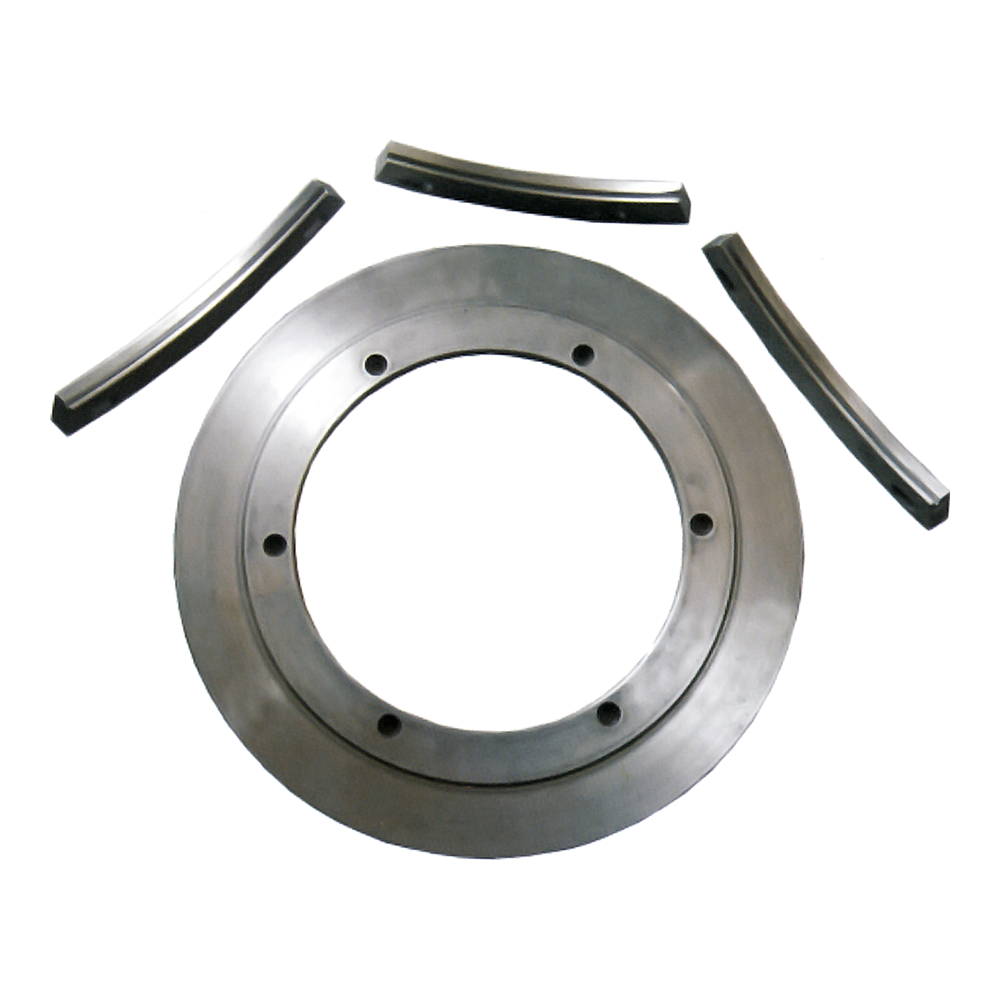
Many conversion press dies are designed with replaceable wear components. This approach allows the user to renew selected working parts instead of replacing the entire die assembly. Replaceable components can reduce maintenance cost and shorten downtime when wear occurs.
The practical value of replaceable parts depends on the availability of correct replacement components and the quality of the installation. Parts should be identified clearly, manufactured to the original dimensions, and checked after replacement. A professional supplier can provide technical guidance concerning adjustment, fitting, and commissioning.
The principal advantage of a double row design is improved output. Two production paths can operate during the same press cycle, allowing the manufacturer to produce more can ends with the available machine time. This can be valuable for large orders, seasonal demand, and factories seeking to increase production without installing a completely new line.
Higher productivity can also improve the utilization rate of associated equipment. Feeding systems, conveyors, inspection units, and stacking equipment can be coordinated with the increased output. When the complete line is properly balanced, the result can be a more efficient production system.
A double row die can provide increased capacity within a relatively compact production arrangement. This may reduce the need for additional building space and simplify the layout of supporting equipment. A compact arrangement can also reduce the distance between press, inspection, stacking, and packing stations.
Space efficiency is particularly useful for established factories where expansion is limited. Before adoption, however, the factory should confirm that the press foundation, feeding equipment, electrical system, ventilation, maintenance access, and finished-product handling areas are suitable for the revised configuration.
Precision tooling helps produce can ends with stable dimensions from one cycle to the next. Consistency is important for seaming, sealing, stacking, filling, and transportation. A can end that varies beyond the acceptable range may cause poor seam formation, leakage, or difficulties during automatic handling.
In a double row system, consistency must be maintained not only over time but also between the two rows. The design therefore emphasizes accurate machining, careful assembly, balanced loading, and proper press adjustment.
When output increases while labor, floor space, and supporting resources remain relatively stable, the processing cost per can end may decrease. The exact saving depends on the production environment, energy consumption, maintenance cost, raw material utilization, and actual operating rate.
Although the initial investment in precision tooling may be higher than that of a simple single-row arrangement, the long-term economic value can be favorable when the die is used consistently and maintained correctly. A complete cost evaluation should include tooling life, replacement parts, downtime, rejects, and the expected production volume.
Modern can-making plants increasingly depend on automatic feeding, transfer, inspection, and stacking. A double row die can be integrated into this type of production environment when its timing, pitch, and discharge arrangement match the rest of the line.
Automation can reduce manual handling, improve production safety, and support more stable quality control. It also allows production data to be monitored more effectively. The tooling should therefore be considered together with the press control system and the upstream and downstream equipment.
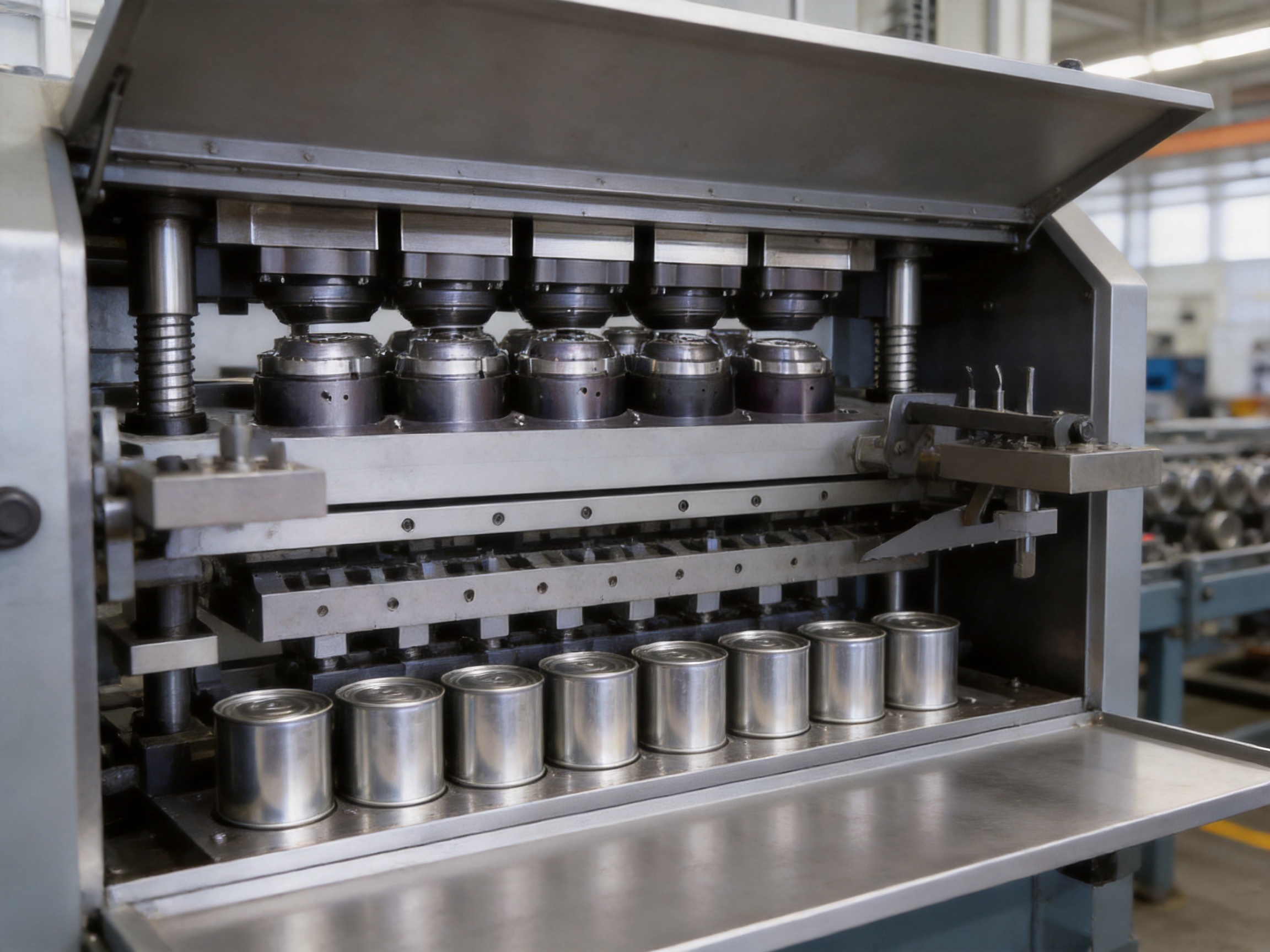
Food cans require reliable sealing and accurate dimensional control. The can end must be compatible with the body seam and must maintain its structural performance throughout sterilization, storage, transportation, and consumer use. A conversion press double row die can be used for suitable food can end designs when the material, tooling, and press conditions are correctly matched.
Food packaging production also places strong emphasis on cleanliness and process control. Operators should keep the die and surrounding equipment free from metal particles, excess lubricant, dust, and other contaminants. Regular inspection supports both product quality and equipment reliability.
Beverage can ends are commonly produced in high volumes, making output and repeatability especially important. The end must support efficient seaming and provide accurate opening functionality where an easy-open design is required. High-speed operation places greater demands on the die, feeding system, press stability, and quality inspection process.
A double row configuration may help beverage can manufacturers respond to large production requirements. The final suitability depends on the end design, line speed, press capacity, and the manufacturer’s technical specifications.
Industrial and chemical containers may use heavier material or larger end structures than ordinary food cans. The die must be designed to handle the required forming force and material thickness. Structural strength, dimensional accuracy, and reliable sealing can be particularly important in these applications.
Because chemical packaging may involve demanding contents and storage conditions, the end design should be developed in accordance with the applicable product and safety requirements. Tooling selection should be based on engineering data rather than appearance alone.
Aerosol can production requires accurate components that can withstand the intended internal pressure and support the correct assembly process. Cone, dome, and related aerosol components may require specialized tooling geometry. A conversion press die for a specific aerosol application must be developed around the exact shape, material, and production sequence.
The use of precision machining and controlled assembly is important in these applications. Any variation in the formed component can affect later operations, including valve installation, sealing, pressure testing, and final packaging.
Other metal packaging products may also benefit from specialized conversion tooling. These can include containers for household products, promotional packaging, industrial goods, and selected consumer products. The double row concept is adaptable when the product geometry and press structure permit parallel processing.
Manufacturing begins with a clear understanding of the required can end. Engineers review the end diameter, shell dimensions, metal type, thickness, score pattern, curl profile, countersink, production speed, and connection requirements with the press. If the tooling is intended to replace an existing die, reference samples and existing drawings may also be evaluated.
This stage is important because tooling errors are expensive to correct after production begins. A professional manufacturer considers the complete forming sequence and identifies potential interference, stress concentration, material movement, and maintenance issues before machining starts.
After the product requirements are confirmed, the engineering team develops the die structure. Computer-aided design can be used to define the working components, guide systems, mounting points, clearances, and row spacing. The design should provide sufficient strength while allowing practical adjustment and maintenance.
The double row arrangement requires special attention to symmetry and load distribution. The two rows should be positioned so that the press can handle the combined forming force without excessive deflection. Tool access, part removal, lubrication, and inspection should also be considered during the design phase.
Working components must be manufactured from materials appropriate for repeated forming and cutting. The selection may consider hardness, toughness, wear resistance, machinability, dimensional stability, and compatibility with heat treatment or surface treatment.
Different parts may require different material characteristics. Cutting and scoring components may need strong wear resistance, while structural plates and support elements may require toughness and resistance to deformation. Material traceability and controlled heat treatment help ensure that the components achieve their intended performance.
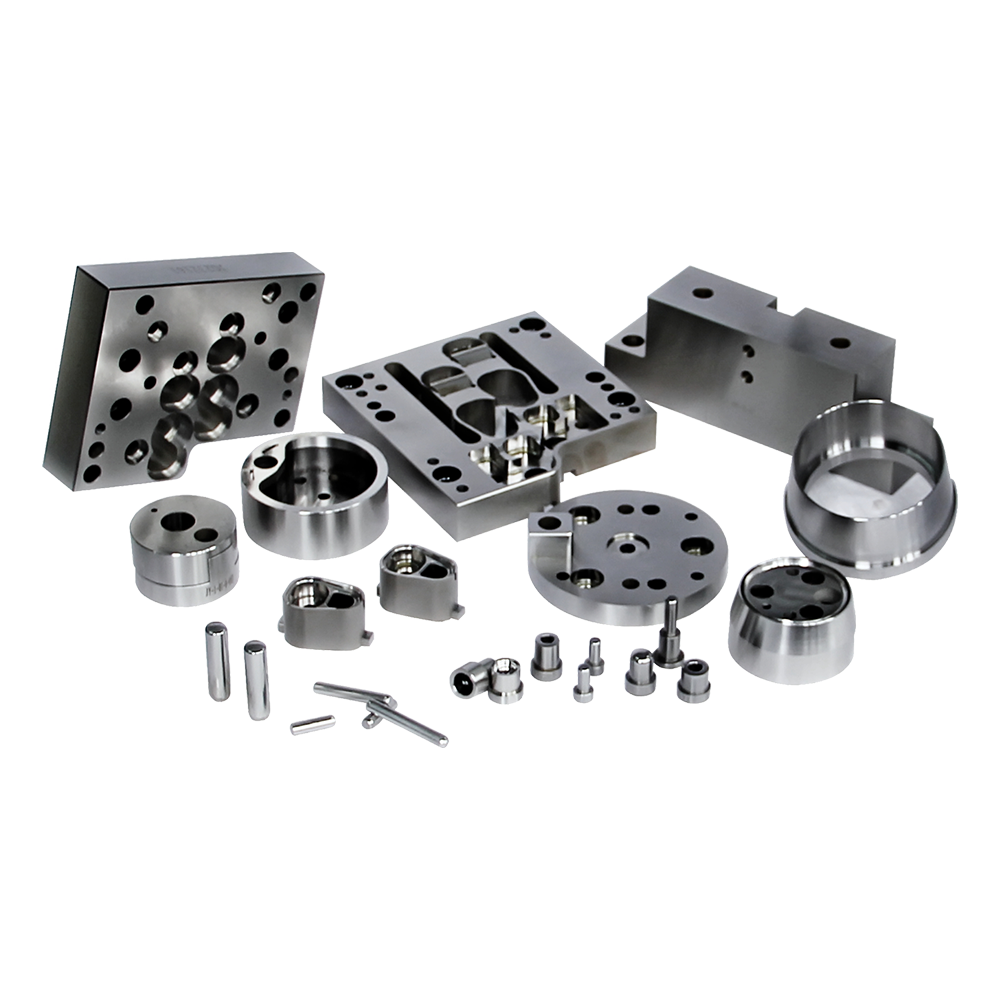
High-precision CNC equipment is used to produce complex profiles, locating features, holes, guide interfaces, and working surfaces. CNC machining helps reduce manual variation and improves repeatability between components. It is particularly valuable for double row tooling because matching components in the two rows must be manufactured to consistent dimensions.
Precision machining is supported by complete mechanical processing equipment. Milling, turning, grinding, drilling, wire cutting, and other processes may be used according to the component requirements. The order of operations is planned to minimize deformation and preserve reference accuracy.
Some components may undergo heat treatment to achieve the required hardness and wear resistance. Heat treatment must be controlled carefully because excessive distortion can reduce dimensional accuracy. After treatment, grinding or other finishing operations may be required to restore the specified dimensions and surface quality.
Surface finishing can improve contact behavior, reduce friction, and support stable metal movement. The appropriate treatment depends on the material and function of each component. A tooling manufacturer with practical experience can select a suitable process without compromising toughness or serviceability.
Each important component should be inspected before assembly. Dimensional inspection verifies critical sizes, profiles, clearances, and positional relationships. Visual inspection can identify burrs, scratches, cracks, incomplete finishing, or other defects.
During assembly, engineers check the interaction of the upper and lower die sets, guide movement, fastener condition, component seating, and row synchronization. The die should move smoothly by hand or with the appropriate assembly tools before installation in the press.
Trial operation provides an opportunity to verify the tooling under controlled conditions. The manufacturer or commissioning team may use sample material to check forming quality, cutting behavior, dimensional stability, feeding, discharge, and press load.
Adjustments may include changing clearances, aligning guides, correcting feeding positions, setting forming heights, or balancing the two rows. The objective is to achieve stable production rather than merely produce one acceptable sample.
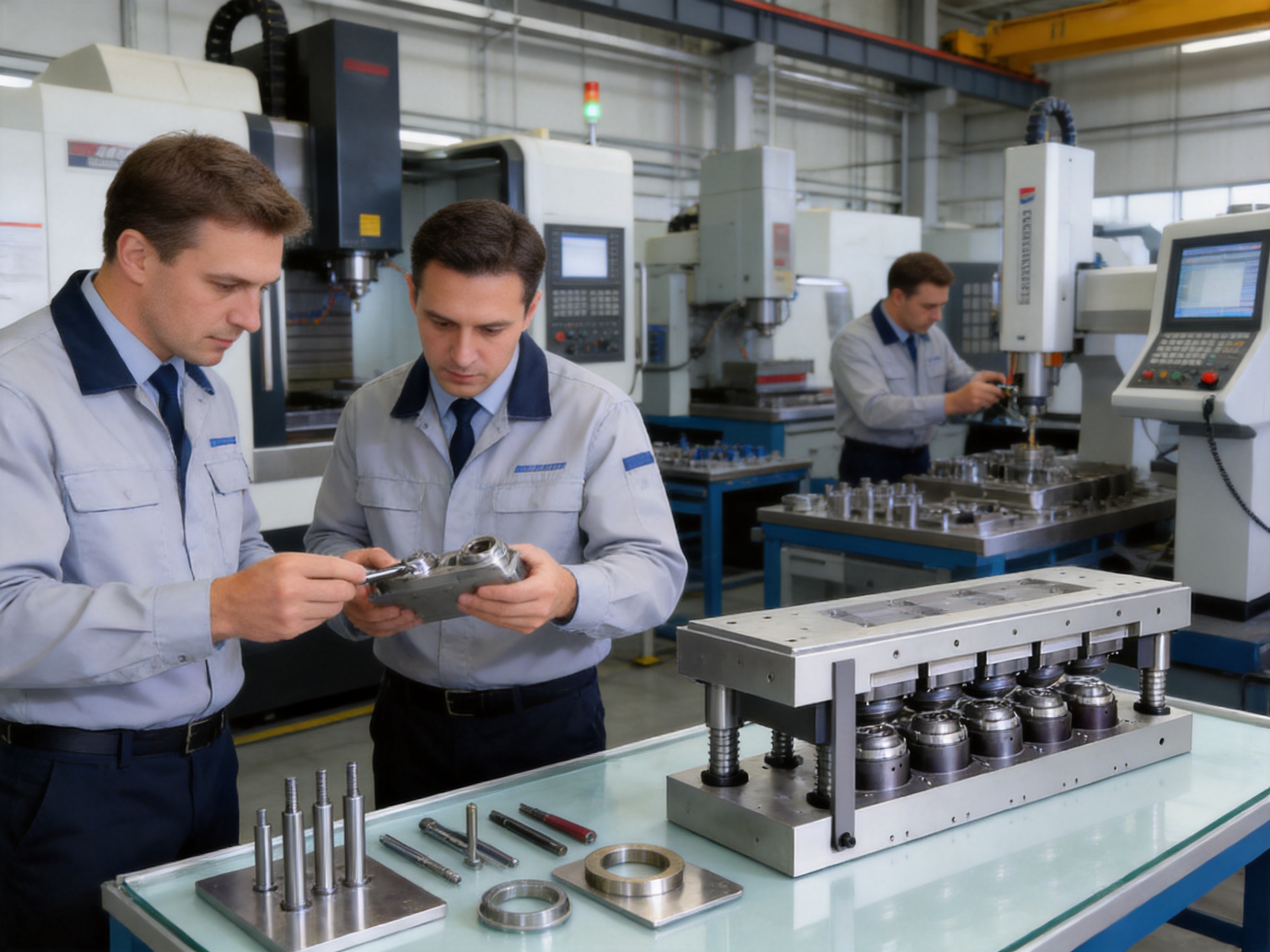
The performance of a precision conversion die depends on more than the design drawing. It also reflects the manufacturer’s equipment, personnel, quality system, production discipline, and accumulated experience. Zhejiang Golden Eagle Food Machinery Co., Ltd. has specialized in can-making machinery and can-making molds since 1978.
The company was formerly known as Zhejiang Food Machinery Factory and Zhoushan Mold Factory. Its long operating history provides experience in the manufacture of equipment and tooling for food cans, beverage cans, can lids, chemical tanks, aerosol containers, two-piece cans, and other metal packaging products.
With more than 350 trained personnel, including experienced design and development engineers, the company has the human resources required to support customized tooling and complete production-line projects. Engineering experience is particularly valuable when a die must be adapted to a customer’s existing press, material, product dimensions, or production method.
The company uses CNC high-precision machining equipment together with complete mechanical processing equipment. This combination supports the production of accurate die components and helps maintain repeatability during machining. Precision equipment is also important for matching the two rows and maintaining the alignment of complicated forming elements.
The company reports that its product design principles are similar to those associated with established European can-making equipment manufacturers, including KRUPP, SOUDRONIC, and ALFONS-HAAR. At the same time, the company combines design knowledge with practical production experience and continuous improvement. This approach allows the tooling to be developed for real factory conditions rather than only theoretical specifications.
Over more than four decades of development, the company has produced more than 10,000 pieces of can and can lid equipment. Such production experience can contribute to better understanding of common operating problems, maintenance requirements, material behavior, and line integration.
A conversion press die must provide reliable operation over a long production period. Quality management begins with design review and continues through material purchasing, machining, heat treatment, inspection, assembly, testing, packaging, and after-sales support.
Zhejiang Golden Eagle Food Machinery Co., Ltd. has been certified to the ISO9001 quality management system. This certification indicates that the company has established documented procedures for managing relevant production and quality activities. A quality system does not replace technical competence, but it provides a framework for consistent control and continuous improvement.
The company has also been certified to the ISO14001 environmental management system. Environmental management is relevant to modern machinery manufacturing because it encourages control of resource use, waste, emissions, and production practices. Customers increasingly consider environmental responsibility when selecting long-term equipment suppliers.
Reliability also depends on correct installation and operation. Even a precision die can suffer damage if the press is overloaded, the material is incorrectly selected, lubrication is inadequate, or foreign objects enter the working area. The manufacturer’s technical guidance is therefore an important part of the product value.
| Evaluation Factor | Single-Row Die | Double-Row Die |
|---|---|---|
| Production paths | One parallel production path | Two coordinated production paths |
| Potential output | Suitable for lower or moderate capacity | Suitable for higher capacity when press conditions permit |
| Space utilization | May require additional equipment for expansion | Can increase capacity within a compact press arrangement |
| Alignment requirements | Requires accurate alignment of one row | Requires accurate alignment and synchronization of two rows |
| Tooling complexity | Generally simpler | More complex and requires balanced design |
| Maintenance planning | Usually straightforward | Requires coordinated inspection of both rows |
| Best application | Smaller orders, flexible production, or lower output | High-volume production and efficient capacity expansion |
The comparison shows that a double row die offers potential productivity advantages, but it also places higher demands on engineering, maintenance, and operating discipline. The correct choice depends on the customer’s actual production requirements. A double row solution is most valuable when the press, feeder, material supply, and downstream equipment can all support the increased rate.
The conversion press double row die may be used as part of a broader can-making machinery production line. Upstream processes can include tinplate preparation, printing, varnishing, slitting, blanking, shell forming, and automatic feeding. Downstream processes can include inspection, sealing compound application, stacking, packing, and transfer to the can assembly area.
Compatibility between the die and the automatic feeding machine is essential. The feeder must present shells at the correct pitch, orientation, and timing. Sensors and control systems should detect missing or misaligned material before it enters the forming area whenever possible.
Press synchronization also affects productivity. The stroke, speed, crank position, transfer timing, and discharge timing must be coordinated. If the press operates faster than the material handling system can support, jams and quality problems may occur. If it operates too slowly, the potential benefit of double row tooling may not be achieved.
Quality inspection should be located at a practical point in the line. Inspection may evaluate dimensions, curl shape, score quality, countersink depth, surface condition, and other product characteristics. Statistical monitoring can identify gradual wear before it leads to large quantities of nonconforming products.
When integrating the die into an existing line, the customer should provide accurate information about the press model, working area, stroke, mounting dimensions, maximum force, feeding arrangement, and product specification. Complete technical information allows the manufacturer to develop a more suitable tooling solution.
Operators should inspect the die, press, feeder, guards, sensors, and lubrication system before beginning production. All mounting bolts should be secure, and the working area should be free from tools, loose metal, and other foreign objects.
The operator should confirm that the correct material and shell specification are being used. Material thickness, hardness, coating condition, and dimensions can affect forming performance. A mismatch between the material and tooling may produce cracks, wrinkles, incomplete forming, or excessive tool loading.
The die should be moved or jogged at low speed during initial setup. This allows the operator to observe alignment and movement before full-speed production. Any unusual noise, resistance, vibration, or interference should be investigated immediately.
During operation, the press should be monitored for abnormal sound, temperature, vibration, material flow, and product quality. A stable production process normally produces consistent parts and predictable machine behavior.
Operators should avoid making uncontrolled adjustments while the press is running. Adjustments should follow approved procedures and should be performed only after the equipment is made safe. The two rows should be checked separately as well as together because a problem may affect only one production path.
Lubrication must be supplied at the correct location and rate. Too little lubrication can increase friction and wear, while excessive lubricant may contaminate the product or interfere with later operations. The appropriate lubricant and schedule should be determined by the tooling and press manufacturer.
After a production run, the die should be cleaned according to the applicable factory procedure. Metal particles, dust, residue, and excess lubricant should be removed carefully. Sharp cutting and scoring areas should be handled with suitable tools and protective equipment.
Operators should record production observations, including output, rejects, adjustments, unusual events, and parts replaced. These records can help maintenance personnel identify trends and plan preventive service.
Preventive maintenance is one of the most effective ways to protect a conversion press double row die. Maintenance intervals should be based on operating hours, production volume, material type, press speed, and the recommendations supplied with the tooling.
Guide components should be checked for wear and proper lubrication. Working edges should be inspected for rounding, chipping, cracks, or uneven contact. Forming surfaces should be examined for scratches and buildup. Fasteners, springs, lifters, and transfer components should also be checked because small failures can interrupt the whole line.
Wear should be measured rather than judged only by visual appearance. A component may appear acceptable but still create dimensional variation if its clearance has changed. Measuring critical features helps the maintenance team determine whether adjustment, grinding, replacement, or complete refurbishment is needed.
When a replacement part is required, the customer should use an approved component with the correct material, hardness, geometry, and surface treatment. Improvised replacement parts can cause poor quality and may damage related components.
Proper maintenance extends tooling life, reduces unplanned downtime, and supports stable production. It can also make operating costs more predictable. For high-volume factories, the value of maintenance is particularly significant because a short interruption may affect a large number of finished products.
An experienced manufacturer can provide more than a physical die. It can contribute to product evaluation, process planning, press matching, installation, commissioning, operator training, and replacement part supply. This broader support reduces the risk that the customer will be left to solve integration problems alone.
Zhejiang Golden Eagle Food Machinery Co., Ltd. provides after-sales services that include installation, commissioning, technical guidance, and operation training. These services can help customers establish correct procedures and shorten the time required to bring new tooling into production.
The company also supplies parts according to customer requirements. Fast access to suitable replacement parts is important for can-making factories because production schedules may be continuous and downtime can be costly. A reliable parts channel supports faster restoration of normal operation.
International experience is another consideration. The company’s equipment and tooling have been exported to Europe, Asia, Africa, North America, South America, and Oceania. Experience with customers in different regions can help the manufacturer understand varied production practices, technical expectations, and service requirements.
For customers seeking a complete line, the company supplies food can production lines, beverage can production lines, can lid production lines, chemical tank production lines, aerosol canister production lines, two-piece can production lines, and pop can production lines. A conversion press double row die can therefore be evaluated within a wider equipment and tooling program.
The first selection factor is the product specification. The customer should define the end diameter, material, thickness, shell form, score design, curl profile, countersink, and required sealing or opening performance. These details establish the basic geometry of the tooling.
The second factor is press compatibility. The press must have suitable capacity, stroke, working height, mounting dimensions, and speed. The available space must accommodate the double row layout and permit safe maintenance access.
The third factor is production volume. A double row die is most appropriate when the required capacity justifies the additional design complexity and investment. Customers should compare expected output with the full cost of tooling, maintenance, energy, labor, material waste, and downtime.
The fourth factor is material handling. The feeder, transfer system, sensors, and discharge equipment must support two synchronized rows. If these systems are not suitable, the die may not reach its potential performance even if its machining quality is high.
The fifth factor is service support. The customer should understand the supplier’s approach to installation, commissioning, training, spare parts, technical documentation, and warranty assistance. A tooling system is a long-term production asset, so support after delivery should be considered during purchasing.
The sixth factor is future flexibility. Some manufacturers may require tooling that can accommodate changes in product design or production requirements. The possibility of interchangeable components, adjustable features, or future upgrades should be discussed during the design stage.
Production efficiency affects both financial performance and resource utilization. A stable double row die can reduce the labor and floor space required for a given output. It can also lower the proportion of rejected products when accurate forming reduces dimensional variation and defects.
Material efficiency is especially important in metal packaging because tinplate and other metals represent a significant part of production cost. Correctly designed tooling supports controlled forming and cutting, helping reduce unnecessary scrap. Actual savings depend on the complete blank layout and material preparation process.
Energy efficiency depends mainly on the press, motor, control system, lubrication method, and line utilization. A double row die may improve output per operating hour, which can increase the number of finished products produced for a given period of machine operation. The total energy result should be evaluated using real production data.
Environmental performance also includes tooling life and repairability. Durable components and replaceable wear parts can reduce the frequency of complete tooling replacement. Proper maintenance prevents premature disposal and supports more responsible use of manufacturing resources.
If one row produces different dimensions or surface conditions from the other, possible causes include unequal alignment, different clearances, inconsistent feeding, uneven wear, or incorrect adjustment. The operator should compare the two rows systematically rather than changing multiple settings at once.
Wrinkles and cracks may result from unsuitable material, excessive forming force, incorrect clearance, poor lubrication, sharp geometry, or inaccurate shell preparation. The problem should be investigated through both material inspection and tooling inspection.
Incomplete forming can occur when the press stroke or forming height is incorrect, the material is not positioned properly, or a working component has worn. It may also indicate that the tooling is not matched to the actual shell dimensions.
Jamming may be related to inaccurate feeder timing, damaged guides, deformed shells, foreign material, insufficient clearance, or a problem in the transfer mechanism. Continuing to operate during a jam can cause serious damage. The equipment should be stopped safely and inspected before restarting.
Rapid wear may be caused by poor lubrication, abrasive contamination, excessive press load, incorrect material hardness, misalignment, or the use of unsuitable replacement components. Preventive inspection can identify the cause before the entire die is affected.
Correct installation establishes the foundation for reliable operation. The die should be mounted according to the approved drawing and installation instructions. Mounting surfaces must be clean and free from burrs, and alignment should be verified before final tightening.
During commissioning, the press is normally operated gradually. The technical team checks the relationship between press movement, feeder timing, transfer action, and discharge. Sample products are inspected after each adjustment to confirm that changes are producing the desired result.
Training should cover safe startup and shutdown, routine lubrication, inspection points, adjustment limits, replacement procedures, and emergency response. Operators who understand the die’s function are more likely to identify abnormal conditions at an early stage.
Documentation should include assembly drawings, part lists, maintenance instructions, recommended inspection intervals, and information about consumable or replacement parts. Clear documentation helps the factory maintain consistent procedures across different shifts.
Can-making machinery continues to develop in response to higher production requirements, lighter materials, improved automation, and more demanding quality standards. Conversion press tooling is likely to benefit from improved computer-aided design, simulation, machining accuracy, surface treatment, sensor technology, and data-based maintenance.
Digital production monitoring can help manufacturers track press load, cycle time, reject rate, tool wear, and maintenance history. Such data may support predictive maintenance and provide earlier warning of abnormal conditions.
Tooling development may also focus on greater flexibility. Customers may need to produce several related end sizes or designs on the same press platform. Modular construction and carefully engineered interchangeable components can help support this requirement where technically practical.
At the same time, fundamental principles remain important. Accurate design, high-quality materials, controlled machining, reliable assembly, balanced operation, and disciplined maintenance continue to determine whether a die performs successfully in a real factory.
It is a precision tooling assembly used in a conversion press to form and process metal can ends through two coordinated production rows. The tooling controls the position and shape of the workpieces during operations such as forming, curling, scoring, beading, or related processes.
The main advantage is the potential for higher output during each press cycle. Two workpieces or two production paths can be processed simultaneously, helping manufacturers improve capacity and use factory space more efficiently.
No. Suitability depends on the press capacity, product design, material, feeding system, production volume, downstream equipment, and maintenance capability. A technical evaluation should be completed before purchase.
Conversion tooling is normally designed according to the can end specification and the customer’s press. Customization may involve dimensions, row spacing, forming sequence, mounting details, material requirements, and replacement part arrangements.
The customer should provide the can end drawing or sample, material type and thickness, shell dimensions, required production speed, press model, mounting information, feeding arrangement, desired output, and any existing tooling references.
Precision machining improves dimensional repeatability, alignment, surface quality, and matching between the two rows. These factors support stable forming, lower variation, reduced wear, and more predictable maintenance.
Maintenance frequency depends on operating hours, production volume, press speed, material, lubrication, and working conditions. The manufacturer’s recommendations should be followed, with additional inspections whenever product quality or machine behavior changes.
Replaceable wear parts are components designed to be renewed after normal service wear. They may include cutting, scoring, guiding, forming, or other working elements. Their use can reduce repair time and avoid replacement of the complete die assembly.
Yes, when the die is matched with the press, automatic feeder, transfer system, inspection equipment, and discharge system. Timing, pitch, sensors, and control signals must be coordinated during commissioning.
Important support may include design consultation, manufacturing documentation, installation, commissioning, technical guidance, operator training, troubleshooting, warranty assistance, and supply of suitable replacement parts.
Both rows must receive the material, perform the forming operation, and discharge the finished ends at the correct time. Poor synchronization may create dimensional differences, jams, uneven loading, and unnecessary wear.
Service life can be supported through correct installation, suitable material, proper lubrication, regular cleaning, accurate adjustment, preventive inspection, protection from contamination, and prompt replacement of worn components.
A conversion press double row die is an important precision tool for manufacturers seeking higher productivity and stable can end quality. Its double-row arrangement can increase output, improve space utilization, and reduce the unit cost of production when the complete line is properly matched and maintained.
The advantages of the die depend on careful engineering. Balanced row design, accurate guides, durable working components, controlled material movement, precision machining, and reliable assembly are all essential. The tooling must also be selected according to the product specification, press capability, material characteristics, and production target.
Zhejiang Golden Eagle Food Machinery Co., Ltd. brings long-term experience in can-making machinery and molds to this type of product. Founded in 1978, the company has developed a broad manufacturing capability supported by trained personnel, experienced engineers, CNC high-precision machining equipment, complete mechanical processing facilities, ISO9001 quality management certification, and ISO14001 environmental management certification.
Its experience in producing can and can lid equipment, together with its ability to supply complete can-making production lines and after-sales services, provides customers with a broader technical resource when planning conversion tooling. Installation, commissioning, technical guidance, operation training, and replacement part support can help customers achieve a smoother transition from tooling purchase to stable production.
For high-volume food, beverage, chemical, aerosol, and general metal packaging applications, a properly designed conversion press double row die can become a valuable long-term production asset. The best results are achieved when the customer and manufacturer work together from the initial product drawing through design, machining, testing, installation, and ongoing maintenance.
1. Metal Packaging Forming Principles, technical reference material for can body and can end production.
2. Press Tool Design and Maintenance, engineering guidance for precision stamping and forming dies.
3. Quality Management Systems—Requirements, ISO 9001 reference standard.
4. Environmental Management Systems—Requirements with Guidance for Use, ISO 14001 reference standard.
5. Industrial Metal Forming and Tooling Practice, reference material on material movement, clearances, wear, and preventive maintenance.
6. Can-Making Machinery Production Line Engineering, technical reference for feeding, conversion, inspection, stacking, and line integration.
7. Manufacturer-provided product and company information concerning conversion press tooling, can-making machinery, manufacturing capabilities, certifications, and after-sales services.
Related Products

Founded in 1978, the company is one of the largest can-making machinery well-known companies at home and abroad.
Product Categories
Contact Information
Zhongshatou Shenjiamen Zhoushan Zhejiang China
+86-580-3056646

 English
 中文简体
中文简体
 русский
 عربى
عربى
 Español