2026-08-14
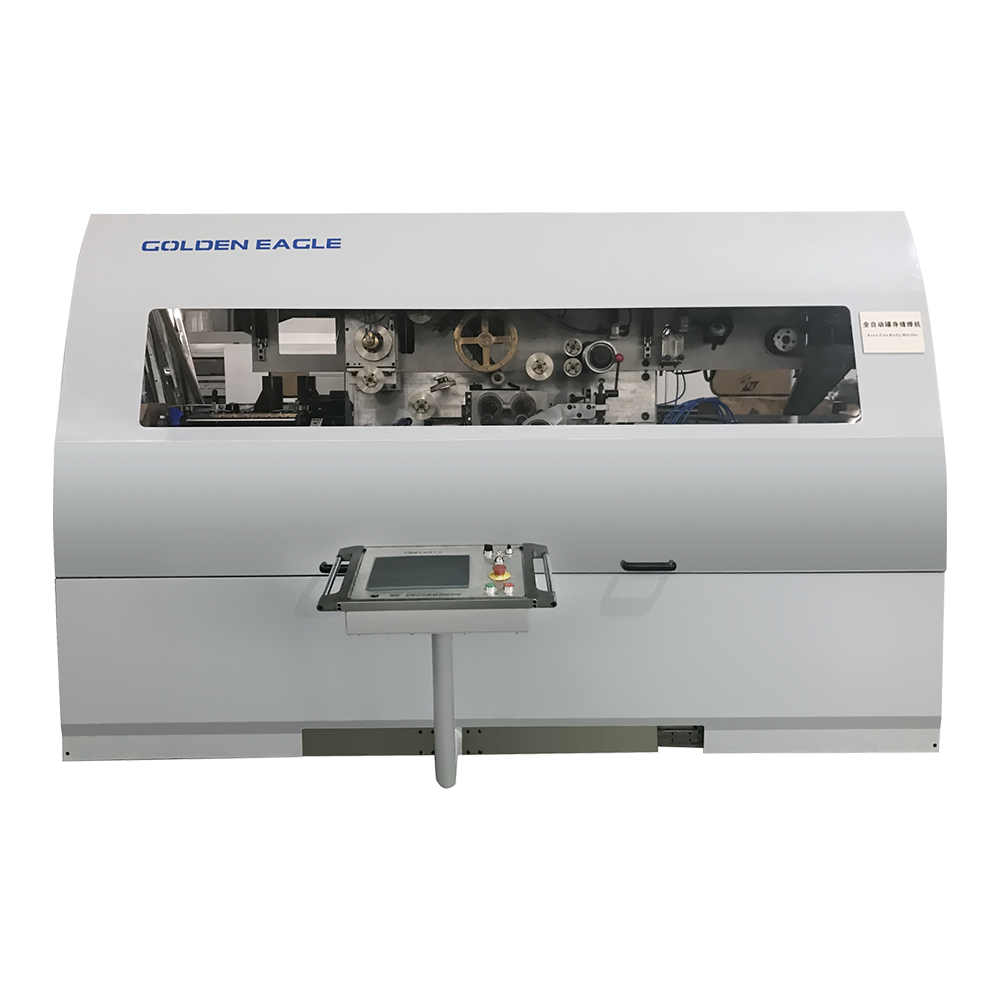
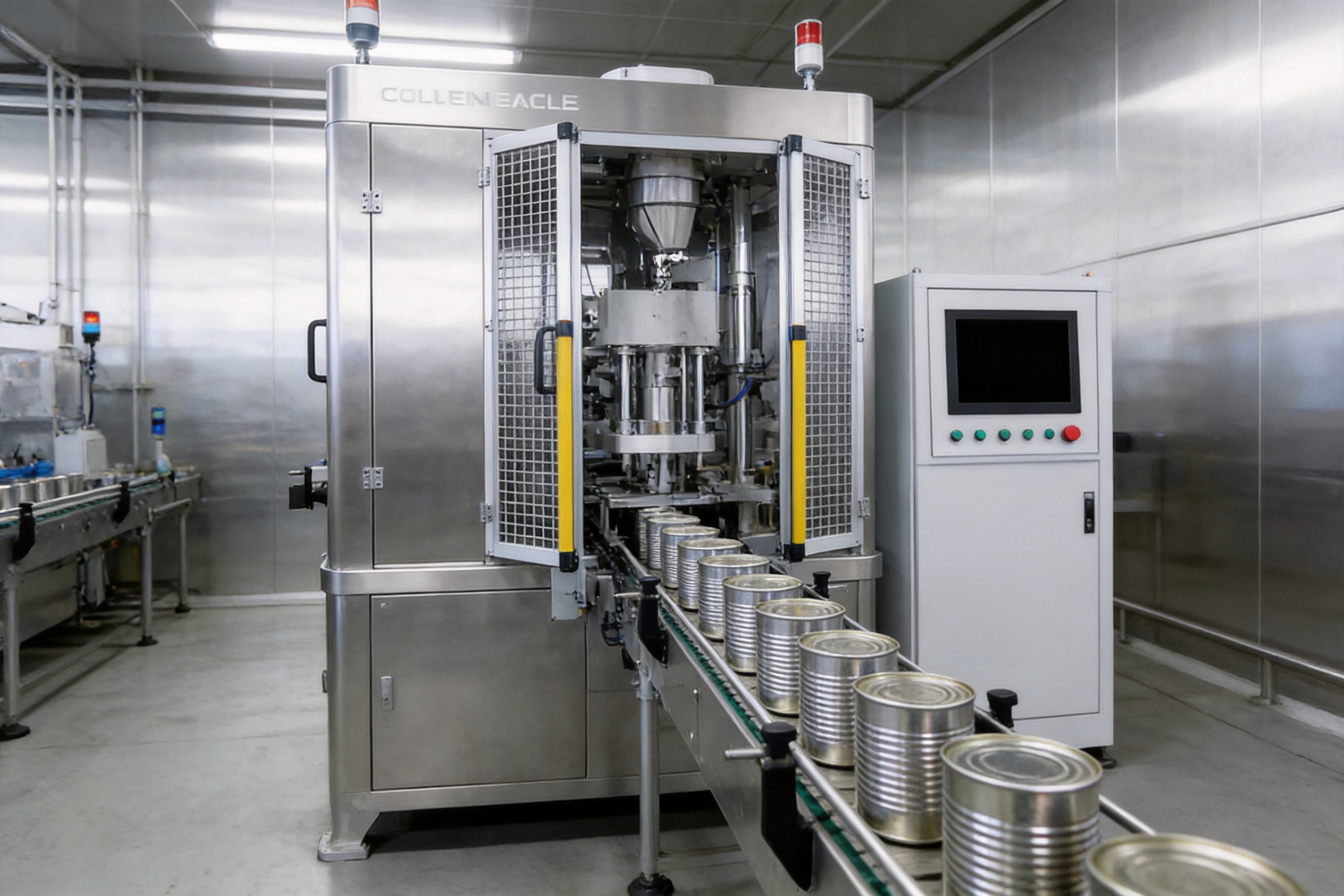
Reliable forming, flanging, beading, and seaming equipment is essential for manufacturers producing food cans, beverage containers, aerosol components, chemical packages, milk powder cans, and other tinplate products. A single-station can making machine provides an efficient and adaptable solution for performing a specific can-making operation with controlled feeding, accurate positioning, stable mechanical movement, and consistent production quality.
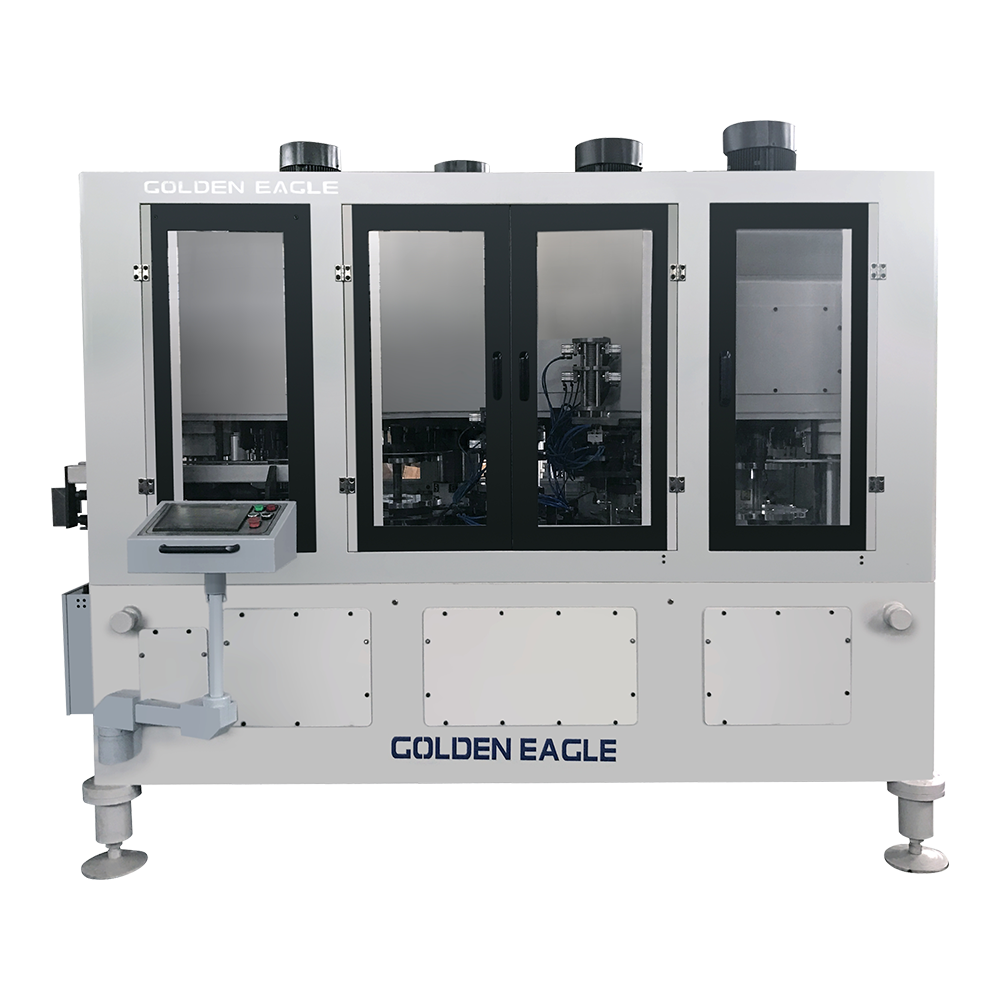
The seaming single-station can making machine described in this article is designed for demanding industrial applications in which production stability, product safety, dimensional accuracy, and convenient format changeover are important. The equipment adopts vertical can feeding and is suitable for aerosol separating and related can-body operations. Its flanging and control systems are designed for dependable operation, while the Mitsubishi PLC-based control system supports accurate process management and straightforward machine operation.
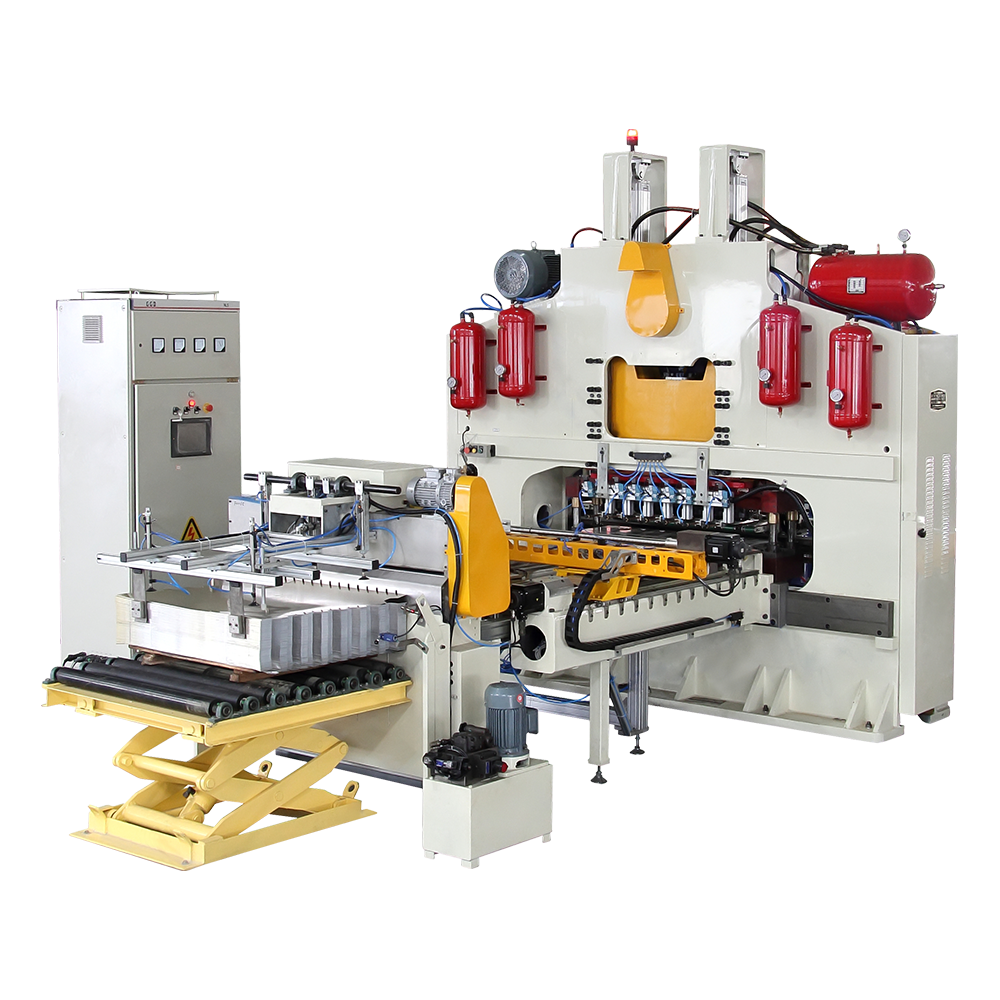
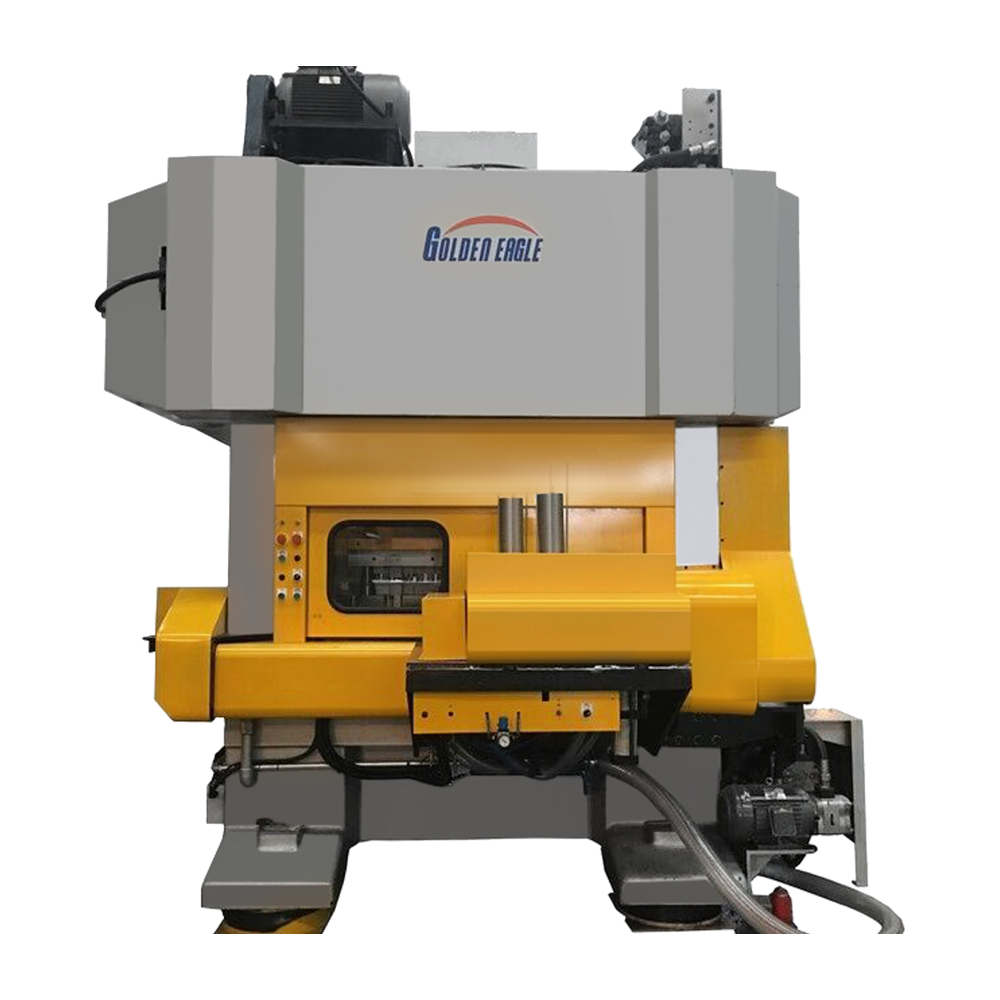
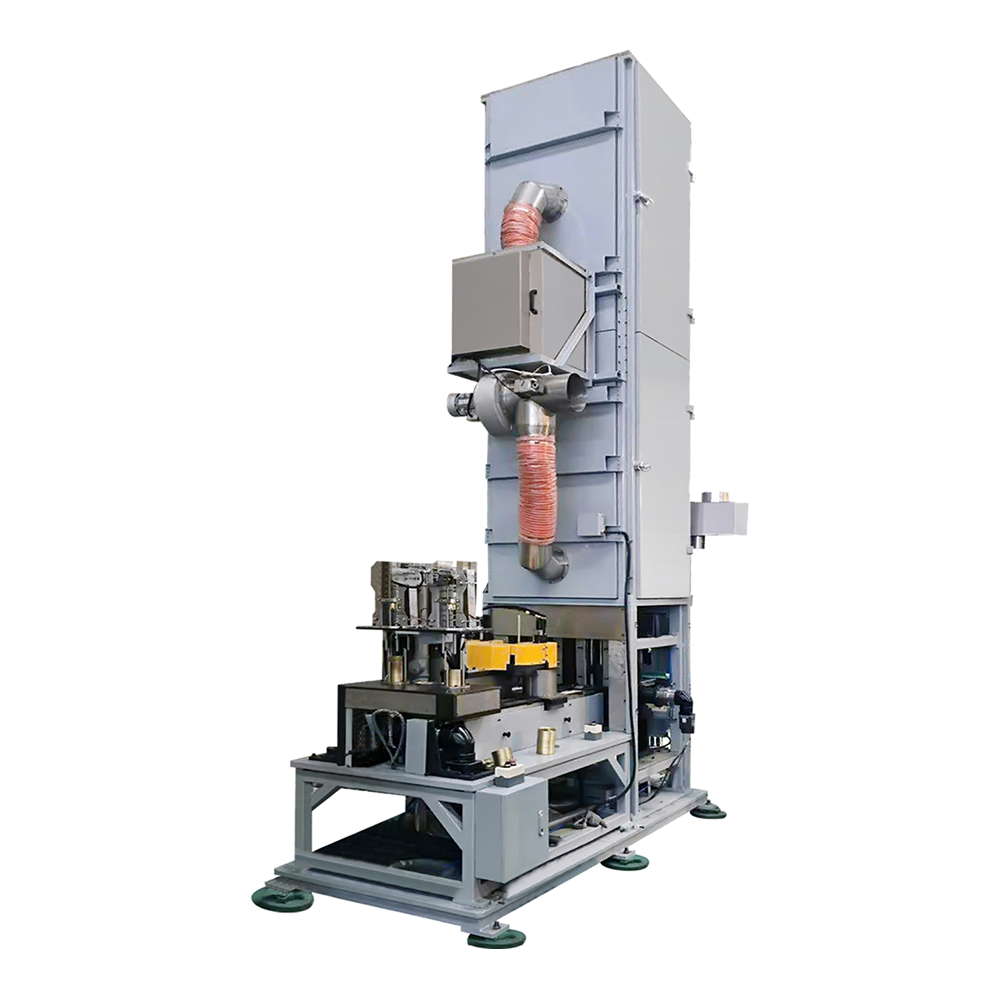
Although the product title identifies the equipment as a seaming single-station can making machine, the related equipment family includes machines for cutting, neck expanding, necking, flanging, beading, and bottom seaming. This broad range allows manufacturers to select a suitable single-station unit or combine several stations into a complete tinplate can production line.
The machine family covers small and medium can diameters as well as large cans. Depending on the selected model, the equipment can process containers from approximately 52 mm to 190 mm in diameter and can accommodate different height ranges. Output varies according to the number of heads, can dimensions, processing function, and operating conditions, with certain configurations reaching several hundred cans per minute.
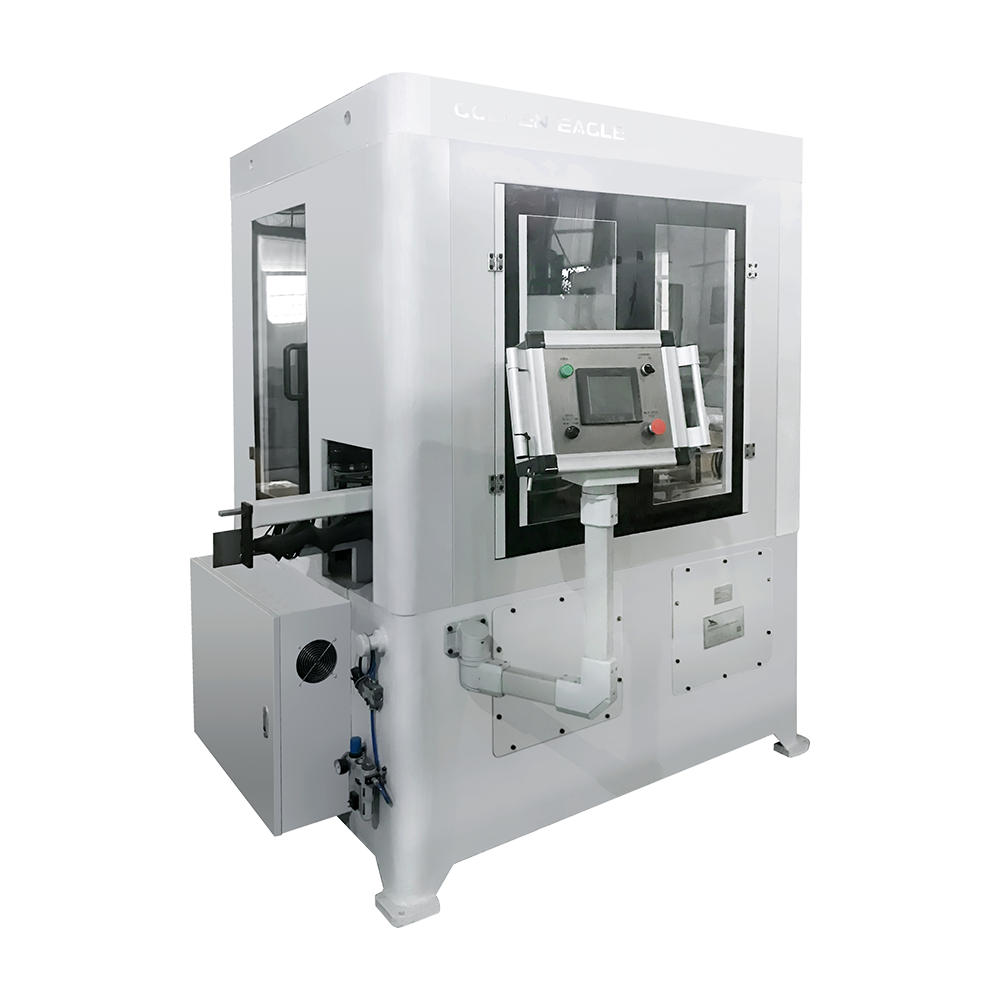
Seaming Single station Can Making Machine
Tinplate can production generally involves several operations. A flat sheet or coil may first be cut and formed into a can body. The body can then be welded, expanded, necked, flanged, beaded, and seamed. Each operation must be synchronized with the previous and following stages. If the dimensions or positioning of one operation are inconsistent, the finished container may not meet requirements for sealing, stacking, filling, transportation, or appearance.
A single-station machine concentrates on one principal operation. This design has several practical benefits. A manufacturer can install only the equipment required for a specific product, add stations as production grows, or replace a bottleneck without rebuilding an entire line. Single-station equipment is also useful for manufacturers producing several container formats because each station can be adjusted or equipped with dedicated tooling for a particular range of diameters and heights.
For seaming applications, the machine joins a can body and a can end through controlled mechanical deformation. A properly formed seam must be secure, continuous, and dimensionally consistent. The seaming process must also avoid excessive deformation that could damage the can body, can end, coating, or internal lining. Stable feeding and accurate can positioning are therefore as important as the seaming heads themselves.
The machine’s vertical can-feeding arrangement helps organize the movement of containers through the working area. A controlled feeding system reduces irregular entry, minimizes manual handling, and supports a continuous production rhythm. Intelligent protection functions further improve operational safety by slowing the machine when cans are absent and stopping it when cans accumulate at the outlet.
Vertical can feeding is a practical arrangement for high-speed industrial production. It helps maintain a defined path for the can body, reduces unnecessary horizontal movement, and supports consistent presentation to the processing station. For aerosol-related separating and flanging work, controlled vertical feeding can help preserve alignment while the machine performs the required operation.
Stable feeding is especially important when the production speed is increased. A can that enters at an incorrect angle or with insufficient spacing can interrupt the process, damage tooling, or cause a defective seam. The feeding arrangement is therefore designed to work together with the machine’s protection and control systems.
The intelligent protection system is one of the machine’s most valuable production features. When no can is detected, the equipment can operate at low speed rather than continuing at full speed under an unfavorable condition. This helps reduce unnecessary mechanical stress and limits the risk of tooling impact or unstable operation.
When cans stack at the outlet, the machine can shut down automatically. This function prevents excessive accumulation from damaging containers or interfering with the next production stage. It also reduces the need for an operator to monitor every discharge movement manually.
Protection functions contribute to longer service life because they help prevent operation under abnormal conditions. They also support safer working practices by providing a controlled response to missing cans, blocked discharge, or other interruptions in the material flow.
The flanging and operating control system adopts a Mitsubishi PLC. A programmable logic controller provides a structured way to manage sensors, motors, feeding movements, speed control, protective responses, and machine sequencing.
PLC control improves repeatability because the machine follows programmed logic rather than relying only on manual adjustment. It also makes troubleshooting more systematic. Operators and maintenance personnel can check the operating sequence, identify abnormal signals, and restore production more efficiently.
The control system is designed for practical operation. The machine can be adjusted for different can sizes, and size changeover can be completed according to the selected tooling and operating requirements. Proper changeover procedures help manufacturers reduce downtime when switching between product specifications.
The main motor uses a stepless frequency changer to adjust speed. This gives the operator greater control over production speed than a fixed-speed arrangement. The appropriate setting can be selected according to can size, material behavior, tooling configuration, product requirements, and the desired output.
Stepless speed adjustment is useful during commissioning and changeover. A new format can initially be operated at a moderate speed while the operator verifies feeding, positioning, forming, and discharge. Once the process is stable, the speed can be increased within the recommended operating range.
Variable-speed operation can also help reduce energy waste during idle or low-demand periods. Instead of operating continuously at the highest rate, the machine can be matched more closely to the actual production requirement and the capacity of connected equipment.
Can manufacturers commonly produce more than one diameter or height. A machine that can be changed over efficiently gives the factory greater flexibility and makes it easier to accept different orders. The described equipment is designed with size changeover in mind, allowing the machine to be configured for the required container dimensions within the limits of the selected model.
Changeover normally involves the replacement or adjustment of tooling, guides, feeding components, and other format-related parts. The exact procedure depends on the machine model and container specification. Operators should follow the manufacturer’s instructions and verify the can dimensions before starting full-speed production.
A well-organized changeover process includes cleaning the working area, checking the condition of tooling, confirming the correct format components, adjusting guides, testing the machine at low speed, inspecting sample cans, and recording the final settings. This approach helps shorten downtime while protecting product quality.
The product family includes several single-station configurations. Each model is designed for a defined operation, can diameter range, can height range, head arrangement, and output capacity. The following functions can be integrated into a can-making production line according to the product design.
Cutting equipment separates material or trims a formed component to the required dimension. Accurate cutting is important because an incorrect edge length can influence later necking, flanging, beading, or seaming operations. Cutting models in the equipment range cover both standard and relatively narrow can diameters.
Neck expanding changes the diameter or profile of a selected part of the can body. This operation may be required for specific packaging designs, closures, or connection arrangements. Controlled expansion helps produce a consistent transition while reducing the risk of uneven deformation.
Necking reduces the diameter of an end section of the can body. It is often used to create a smaller opening or to prepare the body for a compatible can end. The number of heads and the production speed can be selected according to the required diameter range and output target.
Flanging forms an outward edge on the can body. The flange provides the geometry required for a later seaming operation. A uniform flange is essential because variation in flange width, angle, or roundness can affect seam quality.
The equipment family includes standard flanging models and larger-can flanging models. This makes the range suitable for different packaging categories, including smaller cans and larger industrial or chemical containers.
Beading forms circumferential ribs or beads in the can body. Beads can improve rigidity, help maintain the shape of a thin-walled container, and contribute to the overall appearance of the finished package. The correct bead profile depends on the product design, material thickness, and required mechanical performance.
Bottom seaming joins the prepared can body with a can end. This is a critical operation for food cans, milk powder cans, aerosol containers, and other packages that require a secure closure. A stable bottom seam helps protect the contents from leakage, contamination, moisture, and loss of pressure where applicable.
Different bottom-seaming configurations are available for standard and large cans. Four-head, six-head, eight-head, and ten-head arrangements can be selected according to the required diameter range and production capacity. The number of heads affects the relationship between machine speed, output, and the number of cans processed during each cycle.
The following table summarizes the principal models and specifications supplied for the equipment family. Actual performance depends on material, tooling, can design, operator settings, maintenance condition, and the integration of upstream and downstream equipment. The capacities should therefore be treated as reference ranges rather than guaranteed output for every product.
| Model | Head Arrangement | Function | Can Diameter | Can Height | Output Capacity | Total Power |
|---|---|---|---|---|---|---|
| GT3B37A | 4-head | Cutting | 52–99 mm | 40–60 mm after cutting | 80–300 cans/min | 4 kW |
| GT3B37-5 | 8-head | Cutting | 52–65 mm | 40–60 mm after cutting | 200–400 cans/min | 4 kW |
| GT3B42-1 | 4-head | Neck expanding | 52–99 mm | 50–160 mm | 20–150 cans/min | 4 kW |
| GT3B51-N | 4-head or 8-head | Necking | 52–99 mm | 70–160 mm | 80–350 or 550 cans/min | 5.5 kW |
| GT3B51-N-1 | 10-head | Necking | 52–73 mm | 70–160 mm | 450–650 cans/min | 4 kW |
| GT3B51-F | 4-head or 8-head | Flanging | 52–99 mm | 40–160 mm | 80–350 or 550 cans/min | 5.5 kW |
| GT3B51-F-2 | 10-head | Flanging | 52–73 mm | 40–160 mm | 450–650 cans/min | 4 kW |
| GT3B51-B | 4-head or 8-head | Beading | 52–99 mm | 70–135 mm | 200–550 cans/min | 5.5 kW |
| GT3B51-B-2 | 10-head | Beading | 52–73 mm | 70–135 mm | 400–650 cans/min | 4 kW |
| GT3B51-S-3 | 6-head | Bottom seaming | 52–99 mm | 40–160 mm | 80–350 cans/min | 5.5 kW |
| GT3B51-S-5 | 8-head | Bottom seaming | 52–99 mm | 40–160 mm | 200–550 cans/min | 5.5 kW |
| GT3B51-S-2 | 10-head | Bottom seaming | 52–65 mm | 40–160 mm | 450–650 cans/min | 5.5 kW |
| GT3B42B-A | 3-head or 6-head | Large-can necking | 99–153 mm | 150–270 mm | 20–100 or 180 cans/min | 5.5 kW |
| GT3B51-F-C | 3-head or 6-head | Large-can flanging | 99–190 mm | 110–270 mm | 20–100 or 180 cans/min | 5.5 kW |
| GT3B51-S-1B | 4-head | Large-can bottom seaming | 99–165 mm | 100–270 mm | 20–100 cans/min | 4 kW |
| GT3B51-SC2 | 6-head | Large-can bottom seaming | 99–190 mm | 85–320 mm | 20–180 cans/min | 4 kW |
| GT3B51-B-5 | 3-head | Large-can bottom seaming | 99–190 mm | 125–250 mm | 40–70 cans/min | 5.5 kW |
| GT3B51-S-6 | 6-head | Bottom seaming | 99–153 mm | 80–270 mm | 80–250 cans/min | 5 kW |
| GT3B51-7 | 6-head | Bottom seaming | 99–127 mm | 80–270 mm | 80–250 cans/min | 5 kW |
| GT3B51-S-7 | 6-head | Bottom seaming | 99–127 mm | 80–270 mm | 80–250 cans/min | 5 kW |
The table demonstrates the flexibility of the range. Smaller-diameter containers can be processed at particularly high speeds on suitable multi-head models, while large-can versions prioritize controlled forming and stable handling across wider diameters and greater heights. Selecting the correct model requires a review of the can drawing, material specifications, required output, seam design, and available line space.
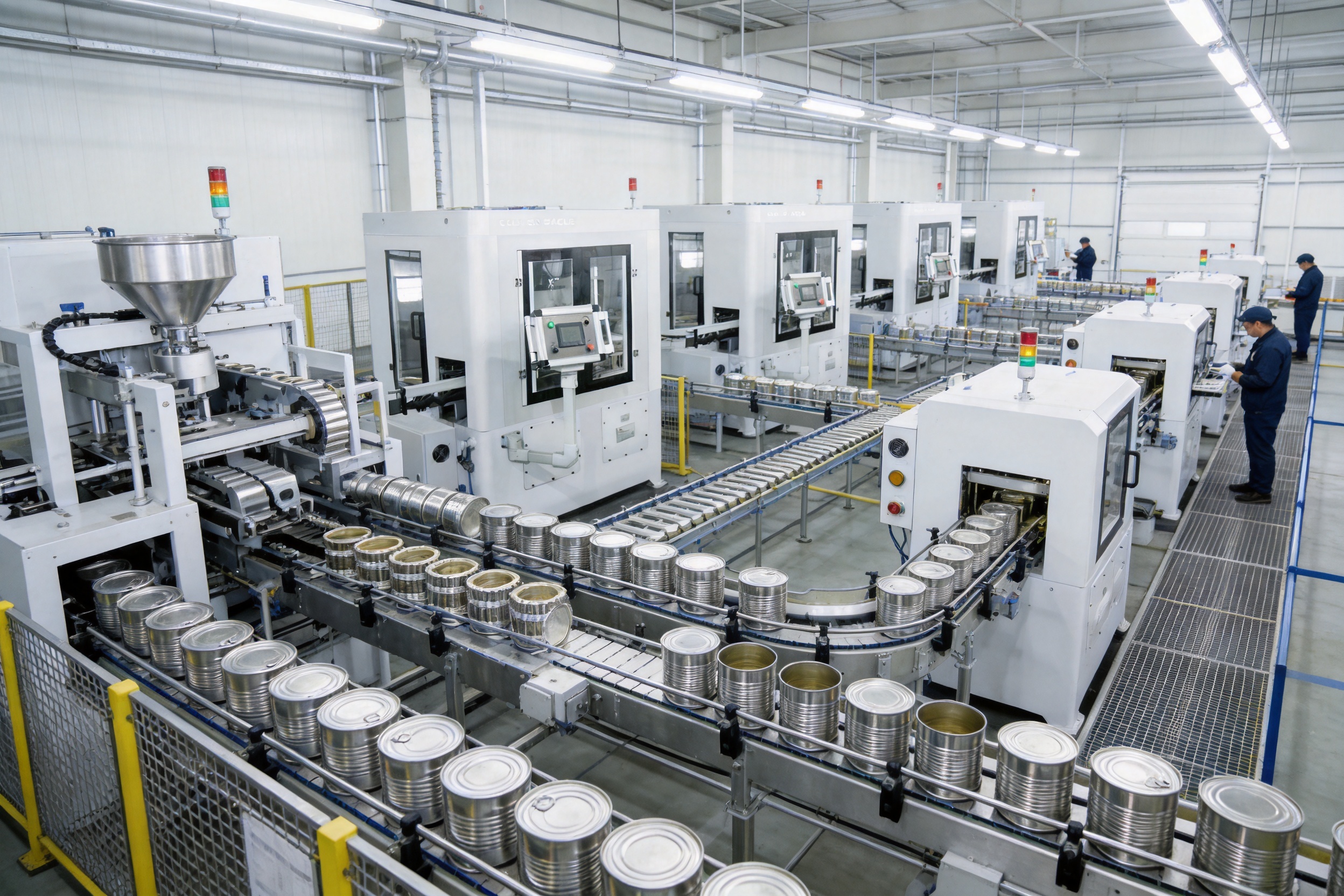
Basic or manually controlled machines may require frequent operator intervention to maintain speed and respond to missing cans or outlet congestion. The described machine combines PLC control, intelligent protection, and variable-speed operation. This combination creates a more controlled production environment and helps reduce variation caused by inconsistent manual operation.
A machine intended for only one fixed container size may be efficient for a single high-volume product but less suitable for a factory serving multiple markets. The available diameter and height ranges, together with changeover capability, allow manufacturers to select equipment that can support several product formats within the limits of the chosen model.
Missing cans and blocked outlets are common causes of disruption in automated can production. Continuing at full speed in either condition can increase the risk of collisions, product damage, and unnecessary wear. Automatic low-speed operation and shutdown behavior provide a more appropriate response than relying exclusively on an operator to notice the problem.
The availability of different head arrangements supports capacity planning. A manufacturer may choose a lower-head configuration for moderate production or a higher-head configuration for large-volume work. This gives the factory a practical way to match equipment investment to current demand while preserving a path for future expansion.
Because the equipment family includes cutting, necking, flanging, beading, and seaming machines, a customer can develop a more consistent production line around compatible machines from one experienced source. This may simplify technical coordination, tooling management, installation, commissioning, and operator training compared with purchasing unrelated machines from several suppliers.
Can quality depends on the relationship between dimensions and operations. A precise flange supports a better seam. A consistent neck profile improves end fit. A uniform bead strengthens the body without creating unnecessary deformation. Stable speed and controlled feeding help these operations produce repeatable results, which can reduce rejects and improve the reliability of downstream filling and packaging.
The manufacturer behind this equipment has a long operating history in can-making machinery and can-making molds. Established in 1978, the company has developed experience across food can production lines, beverage can equipment, can lid production, chemical tank lines, aerosol canister machinery, two-piece can production, and related forming systems.
Its manufacturing organization includes more than 350 trained personnel, including experienced design and development engineers. This combination of mechanical production experience and engineering capability is important for a machine that must coordinate feeding, forming, speed adjustment, sensing, protection, and size changeover.
Tooling is a decisive factor in can-making performance. Even a well-designed machine cannot produce consistent containers if the forming tools are inaccurate, poorly finished, or unsuitable for the material and can drawing. The manufacturer’s experience in both can-making machinery and molds supports closer coordination between the machine structure and the tooling required for each operation.
Integrated development can also simplify the process of confirming replacement tools and format parts. The supplier can evaluate the relationship between the can specification, machine movement, forming profile, and production target rather than treating the machine and tooling as entirely separate products.
The company uses CNC high-precision machining equipment together with a complete range of mechanical processing equipment. CNC machining supports repeatable production of components that require accurate dimensions, consistent alignment, and controlled surface quality.
Precision machining is particularly important for rotating parts, guide components, forming tools, head assemblies, shafts, and other parts involved in synchronized movement. Consistent machining helps reduce unwanted clearance, vibration, and dimensional variation. It also supports easier maintenance because replacement components can be produced to established specifications.
The manufacturer states that its product design principles are similar to those used by established international can-making machinery manufacturers. More importantly, the company has combined these design principles with practical production experience and continued product development.
Can-making equipment must respond to real production conditions. Material properties, coating behavior, can-body tolerances, end-panel design, line speed, operator habits, and maintenance practices all influence machine performance. Continuous improvement based on production experience allows the equipment to be refined for practical use rather than designed only for theoretical operating conditions.
The company has been certified to ISO 9001 quality management and ISO 14001 environmental management systems. Quality management supports documented processes, inspection procedures, corrective actions, and continual improvement. Environmental management encourages more systematic control of resource use, waste, emissions, and production practices.
For industrial buyers, these systems provide useful evidence that manufacturing is organized around repeatable procedures rather than depending solely on individual craftsmanship. Certification does not replace equipment inspection or application testing, but it contributes to a more structured supplier evaluation.
More than 10,000 pieces of can and can-lid equipment have reportedly been produced by the company. Such a production record can contribute to the availability of accumulated design knowledge, spare-part experience, troubleshooting information, and application references.
Experience across many can manufacturers and canning factories also helps the supplier understand the practical requirements of different production environments. These requirements may include compact factory layouts, high-volume food packaging, large chemical containers, aerosol can components, and export installations with different electrical and operational standards.
Food cans require a dependable closure and a clean, controlled production process. Bottom seaming equipment can be used to prepare cans for products such as vegetables, fruit, seafood, meat, sauces, and other shelf-stable foods. The appropriate machine model depends on the can diameter, height, end design, material thickness, and required production rate.
For food packaging, seam consistency is especially important because the finished container must protect the product during filling, thermal processing, storage, and distribution. A stable machine helps the manufacturer maintain dimensional control before the cans enter filling and inspection operations.
Milk powder cans often require precise body dimensions, reliable end attachment, and protection against moisture ingress. The machine range includes configurations suitable for milk powder can manufacturing, subject to confirmation of the can drawing and production requirements.
Efficient changeover can be valuable for manufacturers producing different package sizes for retail, institutional, or export markets. A controlled machine setting helps maintain a consistent appearance and closure performance across multiple formats.
Beverage can production demands high throughput and accurate forming. While the exact process depends on whether the container is a three-piece, two-piece, or specialized design, the equipment family can form part of a broader beverage-can machinery solution. High-head configurations may be considered where the diameter and can height are compatible with the required process.
Aerosol packaging requires careful control of body geometry, necking, flanging, and closure preparation. The described machine adopts vertical feeding and is suitable for aerosol separating and related flanging applications. Large-can and standard-can models provide options for different aerosol container sizes.
Because aerosol containers may be used under pressure, manufacturers must define the applicable material, wall thickness, seam design, pressure requirements, and inspection standards before selecting the equipment. The machine should be integrated with suitable testing and quality-control procedures.
Large tinplate containers and chemical tanks may require wider diameters, greater heights, reinforced bodies, and carefully controlled seams. The large-can models cover diameters up to approximately 190 mm and heights reaching approximately 320 mm on selected configurations.
Industrial containers may also require beading or other reinforcement operations. A production line can therefore combine large-can necking, flanging, beading, and seaming stations to achieve the required structural design.
Before installation, the purchaser should confirm the foundation, floor loading, machine access route, power supply, compressed-air requirements if applicable, ventilation, lighting, and space for maintenance. The machine should be positioned so that operators can safely access feeding, inspection, adjustment, and discharge areas.
Upstream and downstream equipment should be reviewed at the same time. The output of the single-station machine must be compatible with the feeding rate of the next machine. If the seamer operates faster than the discharge conveyor or inspection system, accumulation may occur. If the following machine is faster, the seamer may become the line bottleneck.
Commissioning should begin with mechanical inspection and low-speed operation. The operator should confirm correct rotation, lubrication, sensor response, can travel, tool clearance, emergency-stop behavior, and outlet protection. Trial cans should be inspected for dimensions, flange shape, bead profile, seam appearance, and signs of scratching or deformation.
Only after the machine demonstrates stable operation at a lower speed should production speed be increased. The final operating speed should be selected based on actual product quality and line stability rather than on the maximum published capacity alone.
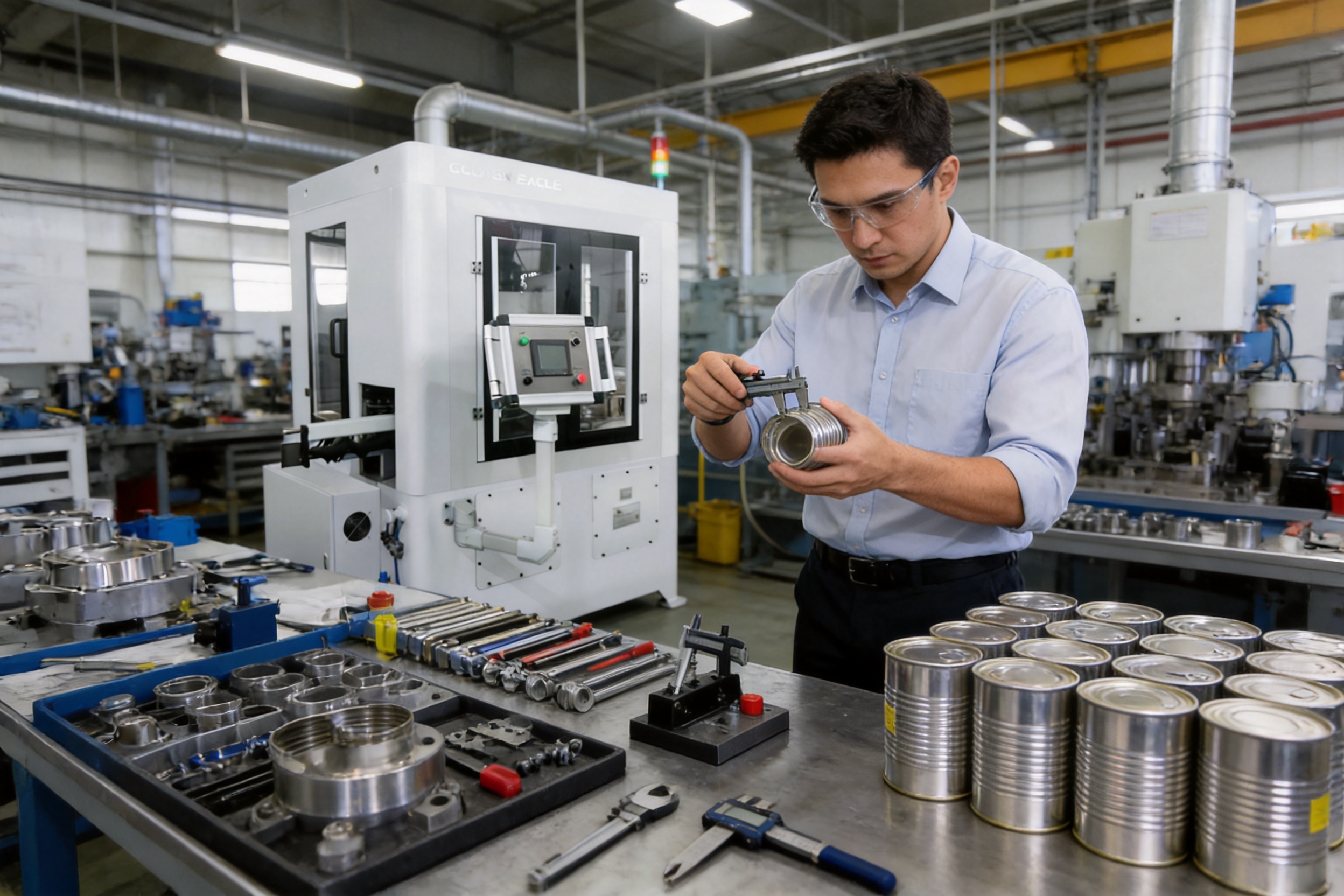
Preventive maintenance helps preserve the machine’s accuracy and output. Operators should keep the working area clean, remove metal fragments and coating debris, inspect guides and tooling, and confirm that moving parts are correctly lubricated according to the maintenance schedule.
Seaming components require particular attention. Wear or incorrect adjustment can influence seam tightness, seam thickness, overlap, and appearance. Tooling should be inspected for damage, abnormal wear, contamination, and incorrect installation. Any adjustment should be recorded so that the production team can identify changes in process behavior.
Electrical cabinets and sensors should be protected from dust, moisture, and unauthorized adjustment. PLC alarms and protection signals should not be bypassed as a routine solution. If the machine stops because cans have accumulated at the outlet, the cause should be corrected before restarting.
Operators should receive training in machine start-up, normal shutdown, emergency stop procedures, format changeover, sample inspection, lubrication, cleaning, and basic troubleshooting. Training is particularly important when several models with different head counts and operating ranges are installed in the same factory.
The first selection factor is the can diameter. The buyer should compare the actual body diameter and end dimensions with the working range of each model. A machine designed for 52–99 mm containers should not be assumed to process a 120 mm can without a specific technical evaluation.
The second factor is can height. Height affects feeding, tool travel, guide adjustment, and the available forming space. The published ranges include short containers, standard cans, and large cans with heights extending to approximately 320 mm on selected models.
The third factor is the required operation. A flanging machine cannot replace a seaming machine, and a beading machine performs a different function from a necking machine. The production sequence should be mapped from the formed body to the finished container before equipment is ordered.
The fourth factor is output capacity. A high-speed ten-head machine may be appropriate for a narrow diameter range and large-volume production, while a four-head or six-head machine may offer more flexibility for a wider diameter range. The buyer should calculate realistic output after allowing for changeover, inspection, planned maintenance, material supply, and normal production interruptions.
The fifth factor is product material and design. Tinplate thickness, coating, welding method, end-panel profile, flange dimensions, bead shape, and seam requirements all influence tooling and machine settings. The supplier should review technical drawings and samples before final confirmation.
The sixth factor is line integration. The machine should be evaluated together with can-body makers, welders, conveyors, inspection equipment, palletizing systems, and filling or packing machinery. A technically capable machine may still create production problems if its interface with neighboring equipment is not properly planned.
Can-making machinery is not a simple general-purpose production machine. It combines material forming, precision tooling, mechanical synchronization, speed management, sensing, and quality inspection. Supplier experience therefore affects both the initial machine performance and the long-term support available to the customer.
A supplier with a broad product portfolio can understand how one operation affects another. For example, a flange produced by one machine must be compatible with the seaming conditions of the next operation. A necked body must match the selected end. A bead must strengthen the can without interfering with subsequent handling or closure.
Experience in complete production lines can also help with factory planning. The supplier may provide guidance on machine arrangement, transfer systems, production flow, commissioning, and operator training. This is particularly valuable for overseas customers establishing a new can-making facility.
Zhejiang Golden Eagle Food Machinery Co., Ltd. provides machinery and molds for several categories of can production. Its reported export experience includes customers in Europe, Asia, Africa, North America, South America, and Oceania. This international exposure may help the company understand different customer expectations concerning documentation, electrical systems, packaging, installation, and after-sales service.
Reliable after-sales support is important because production machinery is expected to operate for many years. The company provides installation, commissioning, technical guidance, operation training, and spare-parts support. These services can help customers move from equipment delivery to stable commercial production more efficiently.
Installation support can assist with machine positioning, connection, initial settings, and coordination with other equipment. Commissioning support can help verify the movement of cans, machine speed, tooling adjustment, protective functions, and sample quality.
Technical guidance is useful when the customer introduces a new can size or changes material conditions. Operation training helps the factory develop a consistent method for start-up, adjustment, cleaning, and shutdown. Spare-parts availability is equally important because worn or damaged components can interrupt production if they are difficult to obtain.
Customers should provide complete technical information when requesting support. Useful information includes the machine model, serial number, can dimensions, material specification, production speed, alarm message, photographs of the affected area, and samples or measurements of defective cans. Clear information can shorten diagnosis time and improve the accuracy of technical recommendations.
Machine performance should be evaluated through regular inspection of finished cans. Visual inspection can identify incomplete forming, scratches, dents, uneven flanges, damaged coatings, improper bead profiles, and abnormal seam appearance.
Dimensional inspection should include the can diameter, height, flange dimensions, neck dimensions where applicable, bead location, and seam measurements. The exact inspection points depend on the container drawing and customer requirements.
For seamed containers, seam evaluation may include seam thickness, seam height, countersink, overlap, tightness, and the absence of wrinkles or fractures. Destructive testing can be used when required to examine the internal structure of the seam. Food, aerosol, and chemical packaging may require additional tests based on the intended application.
Inspection results should be recorded during commissioning and routine production. Trend analysis can reveal gradual tool wear, alignment changes, material variation, or speed-related quality problems before they cause a large quantity of rejected cans.
The value of a single-station can making machine is determined by more than its purchase price. Important economic factors include output, reject rate, changeover time, maintenance cost, energy consumption, tooling life, operator requirements, spare-parts availability, and compatibility with the existing line.
Intelligent protection can reduce the cost associated with collisions and damaged tooling. Variable-frequency speed adjustment can help match production to demand. A suitable head configuration can provide the required output without forcing the customer to purchase an unnecessarily oversized machine.
Efficient size changeover may allow one machine to serve several products. This can increase equipment utilization and reduce the need for separate machines for every container format. However, the actual benefit depends on the frequency of changeover, availability of tooling, operator skill, and the time required to verify the new format.
Long-term value also depends on the manufacturer’s ability to supply service and parts. A machine supported by an experienced engineering organization is generally easier to maintain and adapt than equipment for which documentation and replacement components are difficult to obtain.
A single-station can making machine is equipment designed to perform one principal can-making operation, such as cutting, necking, flanging, beading, or bottom seaming. Several stations can be combined to create a complete production line.
The featured product is identified as a seaming single-station can making machine. Its related equipment range also includes cutting, neck expanding, necking, flanging, beading, and large-can bottom-seaming configurations. The exact operation depends on the model selected.
The machine adopts a Mitsubishi PLC control system for the flanging and operating controls. The PLC manages programmed sequences and works with sensors and protection functions to support stable operation.
The intelligent protection system can reduce the machine to low speed when no can is detected. This helps limit unnecessary high-speed operation and reduces the risk of unstable processing.
The machine is designed to shut down when cans stack at the outlet. The operator should remove the cause of the accumulation and check the discharge path before restarting the machine.
Yes. The main motor uses a stepless frequency changer, allowing the operating speed to be adjusted within the suitable range for the selected model, tooling, can size, and production conditions.
The listed models cover can diameters from approximately 52 mm to 190 mm. The applicable range depends on the model and function. Buyers should confirm the exact can drawing before selecting equipment.
Some ten-head models are listed with capacities reaching 650 cans per minute, while other models have lower ranges appropriate for larger cans or different operations. Actual output depends on can design, material, tooling, speed, and line conditions.
Yes. Several large-can models support diameters from approximately 99 mm to 190 mm. Selected configurations accommodate can heights reaching approximately 320 mm.
The product information states that the machine is suitable for aerosol separating and related flanging work. Aerosol applications require confirmation of the container design, material, pressure requirements, tooling, and inspection standards.
The choice depends on the can diameter range, required capacity, operation, product design, and production schedule. Higher-head configurations may provide greater output for compatible narrow diameter ranges, while other configurations may offer wider format coverage.
The company manufactures both can-making machinery and can-making molds. Tooling requirements should be discussed together with the machine order so that the forming profile, can dimensions, and operating conditions are properly matched.
Reported after-sales services include installation, commissioning, technical guidance, operation training, and spare-parts supply. The specific scope should be confirmed in the purchase agreement.
A technical inquiry should include the can diameter, can height, material type and thickness, can-body construction, end design, required operation, target output, drawings or samples, power requirements, and the planned production-line layout.
Yes. The machine family includes equipment for several can-making operations and can be used as part of a complete food can, beverage can, can lid, chemical tank, aerosol, two-piece can, or related production line, subject to technical compatibility.
The seaming single-station can making machine is a flexible solution for manufacturers that require controlled can processing, reliable feeding, adjustable speed, intelligent protection, and practical format changeover. Its PLC-based control system, vertical can feeding, low-speed response when cans are absent, and automatic shutdown during outlet accumulation contribute to stable and safer production.
The wider model range supports cutting, neck expanding, necking, flanging, beading, and bottom seaming for both standard and large cans. With diameter coverage from approximately 52 mm to 190 mm and output options extending to several hundred cans per minute, the equipment can be configured for different production requirements.
The manufacturer adds value through long-term experience, a broad product portfolio, integrated mold production, CNC precision machining, engineering resources, quality and environmental management systems, international applications, and after-sales support. These strengths make the equipment suitable for manufacturers seeking not only an individual machine but also a coordinated solution for tinplate can-making machinery production lines.
Before purchase, every customer should confirm the can drawing, material specifications, operation sequence, target capacity, tooling requirements, utility conditions, and line interfaces. With the correct model and proper commissioning, the machine can contribute to consistent seams, efficient production, reduced interruptions, and dependable long-term can manufacturing performance.
1. Product specification materials for the single-station can making machine and associated cutting, necking, flanging, beading, and bottom-seaming models.
2. Manufacturer information concerning company history, engineering personnel, manufacturing facilities, certifications, production experience, export markets, and after-sales services.
3. General principles of tinplate can-body forming, flange preparation, beading, and mechanical double-seam production.
4. ISO 9001 quality management system principles for manufacturing organizations.
5. ISO 14001 environmental management system principles for industrial production.
6. General industrial guidance for preventive maintenance, machine commissioning, format changeover, and quality inspection of metal containers.
Related Products

Founded in 1978, the company is one of the largest can-making machinery well-known companies at home and abroad.
Product Categories
Contact Information
Zhongshatou Shenjiamen Zhoushan Zhejiang China
+86-580-3056646

 English
 中文简体
中文简体
 русский
 عربى
عربى
 Español